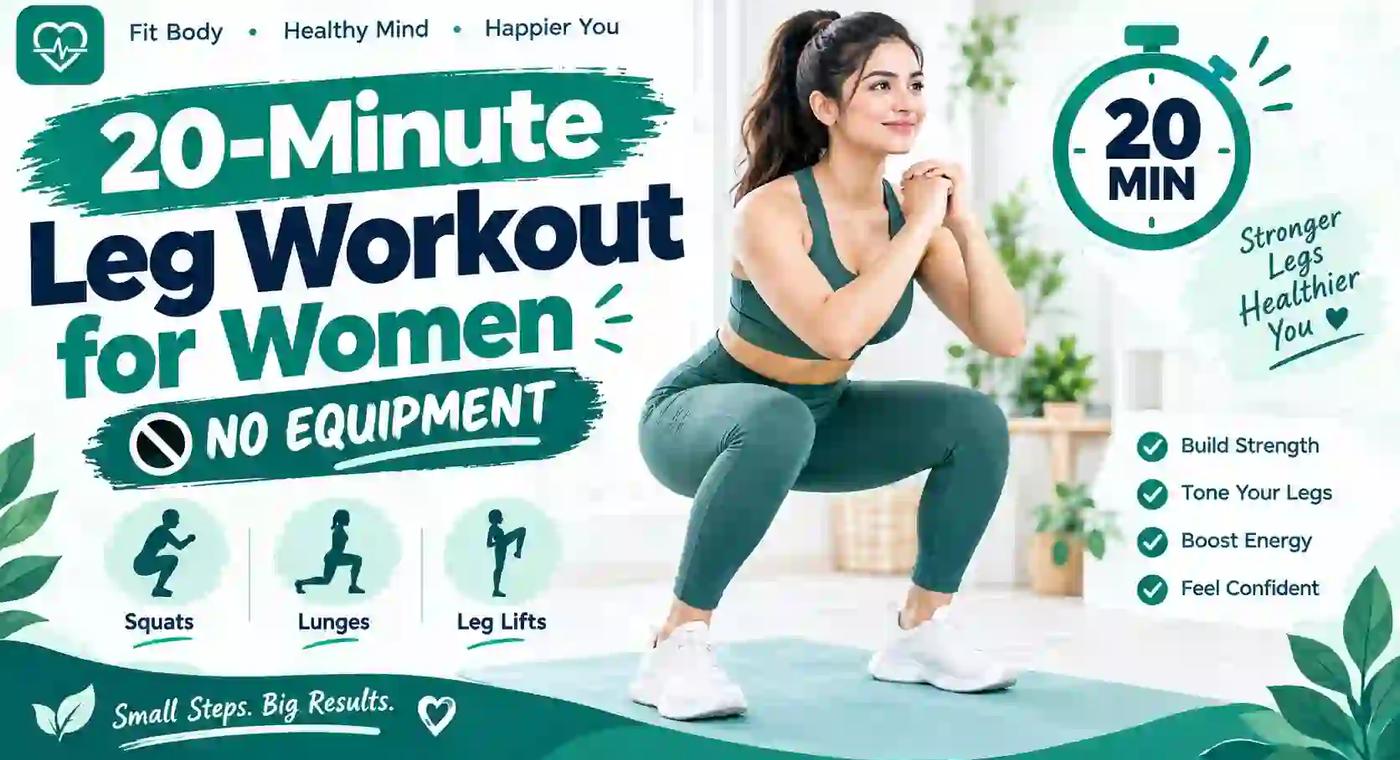
20-Minute Leg Workout for Women: No-Equipment Routine
Try this 20-minute leg workout for women to target quads, hamstrings, glutes, and calves with no equipment. Follow this quick home routine.
You don't need an hour at the gym to feel the burn in your legs. A well-structured 20-minute leg workout for women can hit every major muscle group — quads, hamstrings, glutes, and calves — without any equipment, without a commute, and without derailing your entire day.
This guide walks through exactly how to build an effective quick leg workout, why 20 minutes is genuinely enough time when the exercises are chosen well, and how to structure your week so short sessions actually translate into real strength over time. Whether you're a total beginner or someone who just wants a faster way to train, you'll walk away with a complete, ready-to-use routine.
Why a 20-Minute Leg Workout Actually Works
There's a common assumption that shorter workouts are automatically less effective, but that's not quite how muscle-strengthening works. What matters more than total time is whether you're training the right muscle groups with enough intensity and consistency.
According to the CDC's Physical Activity Guidelines for Americans, adults need at least 150 minutes of moderate-intensity aerobic activity per week, along with muscle-strengthening activity on two or more days that works all major muscle groups. A focused 20-minute leg session, done a couple of times a week alongside your other activity, fits naturally into that framework — it's a genuinely useful building block, not a replacement for all weekly movement.
It's worth being precise here: a single 20-minute leg workout is a session, not your entire weekly activity requirement. Think of it as one effective piece of a broader routine rather than a complete solution on its own. If you want help mapping out how this fits into your full week, a workout planner can help you balance leg days with cardio, rest, and upper-body work without overloading any single day.
What makes a short leg workout effective:
- Compound movements like squats and lunges recruit multiple muscle groups at once, so you get more return per minute than isolation exercises.
- Minimal rest between exercises keeps your heart rate elevated and your muscles working continuously.
- Consistency over duration. Two focused 20-minute sessions a week will out-perform one exhausting 90-minute session you dread and skip half the time.
If you're brand new to structured training altogether, it's worth starting with the fundamentals in this beginner home workout plan with no equipment before layering in more intense leg-specific circuits.
What Muscles Should a Leg Workout Target?
A genuinely complete leg workout doesn't just hammer your quads and call it done. Your lower body is made up of several major muscle groups, and each one plays a distinct role.
- Quadriceps (front of thigh): Powers squats, lunges, and stair climbing.
- Hamstrings (back of thigh): Controls hip extension and knee flexion; often undertrained relative to the quads.
- Gluteus maximus and gluteus medius: Your primary hip extensors and stabilizers — critical for both power and knee alignment.
- Calves (gastrocnemius and soleus): Support ankle stability and push-off power in every step you take.
- Hip flexors and adductors: Often neglected, but essential for balance and injury prevention, especially in lateral and rotational movements.
A well-designed 20-minute routine touches all of these, not just the muscles that feel most obvious to train.
The Complete 20-Minute Leg Workout (No Equipment Needed)
Here's a structured session built around compound, bodyweight movements that any woman — beginner or more experienced — can adapt. Perform this as a circuit: move through each exercise with minimal rest, then rest 60–90 seconds between full rounds.
Warm-Up (3 minutes)
Skipping the warm-up is one of the most common mistakes in short workouts, since a rushed 20-minute session often tempts people to cut it. Don't. A few minutes of movement prep reduces injury risk and improves performance in the exercises that follow.
- 30 seconds marching in place
- 30 seconds bodyweight squats (slow, controlled)
- 30 seconds hip circles (each direction)
- 30 seconds standing quad stretch (each leg)
- 30 seconds walking lunges (light, warm-up pace)
- 30 seconds ankle circles and calf raises
Circuit (Repeat 3 rounds, 40 seconds work / 15 seconds rest per exercise)
1. Bodyweight squats
Feet shoulder-width apart, chest up, lower until thighs are roughly parallel to the floor, drive through your heels to stand. This is your foundational quad-and-glute movement.
2. Reverse lunges (alternating legs)
Step backward rather than forward — this places less shear stress on the knee joint, which makes it a smart choice for beginners or anyone managing knee sensitivity.
3. Glute bridges
Lie on your back, knees bent, feet flat. Squeeze your glutes to lift your hips until your body forms a straight line from shoulders to knees. Hold briefly at the top.
4. Static wall sit
Back against a wall, knees at roughly 90 degrees. This isometric hold builds muscular endurance in the quads and is deceptively challenging for its simplicity.
5. Lateral lunges
Step wide to one side, bending that knee while keeping the other leg straight, then push back to center. This targets the adductors and abductors that forward-only movements tend to skip.
6. Calf raises
Rise onto your toes, pause, lower slowly. Simple, but genuinely effective for calf strength and ankle stability.
Cool-Down (2 minutes)
- Standing hamstring stretch (30 seconds each leg)
- Standing quad stretch (30 seconds each leg)
- Seated figure-four stretch for the glutes (30 seconds each side)
- Deep breathing while standing
Total time: roughly 3 minutes warm-up + 14–15 minutes circuit + 2 minutes cool-down = right around 20 minutes.
How to Make This Workout Harder (or Easier)
One of the biggest strengths of a bodyweight circuit is how easily it scales. You don't need a gym membership to add intensity.
To make it harder:
- Add a jump to your squats (squat jumps) for a plyometric element.
- Slow down the eccentric (lowering) phase of each rep to 3–4 seconds.
- Extend your wall sit hold time or add a second round of it.
- Hold light dumbbells, water bottles, or a loaded backpack during squats and lunges.
- Reduce your rest periods from 15 seconds to 10.
To make it easier (genuinely a smart starting point, not a shortcut):
- Perform squats and lunges with a chair nearby for balance support.
- Reduce range of motion on squats until mobility improves.
- Shorten work intervals to 30 seconds with 20 seconds of rest.
- Skip the wall sit initially and replace it with standing marches.
This is exactly the kind of individualization that current exercise science emphasizes. Rather than a single "correct" version of a workout, the goal is matching intensity and load to your current fitness level and adjusting as you improve. If you're unsure where you currently stand, this guide on structuring a workout plan from beginner to advanced walks through how to progress safely over time.
How Often Should Women Train Their Legs?
This comes up constantly, and the honest answer depends on your broader training split — but there are useful general guidelines.
For most women doing bodyweight or light-resistance leg training, two to three sessions per week allows enough stimulus for improvement while leaving adequate recovery time between sessions. Training legs on consecutive days without rest can limit results, since muscles rebuild and strengthen during recovery, not during the workout itself.
If you're combining this leg routine with other training (upper body work, cardio, yoga), spacing your leg days two to three days apart tends to work well for most people. This cardio and strength training guide explains how to balance both types of training across a week without one undermining the other. If you're newer to structured exercise, this beginner weekly workout plan offers a realistic starting framework.
Bodyweight vs. Weighted Leg Training: Which Should You Choose?
This is a genuinely common point of confusion, so it's worth addressing directly rather than glossing over it.
Bodyweight training is highly effective, especially for beginners and for time-efficient home workouts. It builds real strength, improves muscular endurance, and requires zero equipment or setup time — which is exactly why it fits so well into a 20-minute format.
Weighted training (dumbbells, resistance bands, kettlebells) becomes more valuable as your bodyweight strength improves and you need additional resistance to keep progressing. This is where the concept of progressive overload comes in — gradually increasing the demand on your muscles over time so they continue adapting rather than plateauing.
A practical approach: start with bodyweight circuits like the one above, and once squats and lunges start to feel genuinely easy rather than challenging by round three, that's your signal to add resistance — even something as simple as a filled water jug or a resistance band works well at home. Tracking this kind of progress over weeks, rather than judging a single session, is where a monthly workout planner becomes genuinely useful.
Fueling and Recovering From Leg Day
Training is only half the equation. What you eat and how you recover shapes whether those 20-minute sessions actually translate into visible strength gains.
Protein matters more than most people think for muscle repair after resistance-style training, even bodyweight sessions. If you're unsure how much you personally need, this breakdown of how much protein you need per day is a useful starting point.
Hydration affects performance more than most people realize, especially once you start adding intensity or resistance to your leg circuits. If you're training regularly, this guide on electrolyte needs during weight training covers what actually matters beyond just drinking more water.
Recovery isn't optional. Sore, fatigued legs that haven't had time to rebuild won't perform well in your next session, and pushing through that fatigue repeatedly increases injury risk rather than accelerating results.
If your broader goal involves changing body composition alongside strength — building muscle while managing fat — this guide on losing fat and gaining muscle through body recomposition explains how strength training like this leg circuit fits into that bigger picture, and a body fat estimator can help you track changes over time more accurately than the scale alone.
Common Mistakes That Undermine Quick Leg Workouts
A handful of avoidable errors show up repeatedly in short home workouts, and fixing them makes a real difference in both results and injury prevention.
- Skipping the warm-up to save time. Ironically, this often costs more time in the long run through reduced performance or minor strain injuries.
- Letting knees cave inward during squats and lunges. This is one of the most common form breakdowns and puts unnecessary stress on the knee joint. Keep knees tracking in line with your toes.
- Rushing through reps. Fast, sloppy reps reduce muscle engagement and increase injury risk. Controlled tempo, especially on the lowering phase, produces better results even at lower rep counts.
- Training the same muscles every single day. Legs, like any muscle group, need recovery days to actually adapt and strengthen.
- Ignoring the posterior chain. Many at-home leg routines overemphasize the quads (squats, lunges) while neglecting hamstrings and glutes, which leads to muscular imbalances over time.
- Expecting dramatic visual change in days. Muscle adaptation and visible toning take consistent weeks of training, not a handful of sessions — patience matters here more than intensity.
For a broader look at why some routines stall out entirely, this article on common workout planning mistakes that slow results covers issues beyond just leg training specifically.
What to Do Before and After Your Leg Workout
Before your session: a brief dynamic warm-up (as included above) prepares your joints and muscles for the movement ahead. Light cardio for a minute or two — marching, jumping jacks, or a quick walk around your space — also helps raise your heart rate gradually rather than shocking your body straight into squats.
After your session: static stretching while your muscles are still warm improves flexibility more effectively than stretching cold. Give yourself a few minutes of deep breathing and hydration before moving on with your day. If you're tracking your heart rate during training, this heart rate zone guide explains how to train smarter based on intensity zones rather than guessing.
Fitting This Into a Busy Schedule
One of the biggest advantages of a 20-minute format is how realistically it fits into an already-packed day. You don't need to block out a full evening or plan around gym hours.
If leg day specifically feels hard to fit in, this 30-minute workout plan for busy people shows how to structure a slightly longer session that still respects a tight schedule, and a step counter and goal planner can help you stay active on the days you're not doing a structured leg session at all.
Frequently Asked Questions
Is a 20-minute leg workout enough?
Yes, when the exercises are compound movements performed with minimal rest and good form. A 20-minute session can effectively train quads, hamstrings, glutes, and calves, especially when done consistently two to three times a week alongside general weekly activity.
How often should women train their legs?
Most women benefit from two to three leg-focused sessions per week, with at least one rest day between sessions to allow muscles to recover and rebuild.
Can I build real muscle with only bodyweight exercises?
Yes, particularly if you're newer to strength training. As bodyweight exercises start feeling easier, adding resistance through bands, dumbbells, or household objects helps you continue progressing.
Should I do cardio on the same day as my leg workout?
It's fine to combine them, though the order matters. Doing leg-focused strength work before cardio generally preserves more strength and power for the resistance portion of your session.
How can I avoid knee pain during leg exercises?
Keep your knees tracking in line with your toes rather than caving inward, avoid locking your knees at the top of movements, and reduce range of motion if you feel discomfort rather than pushing through pain.
What should I eat after a leg workout?
A meal or snack with protein supports muscle repair, while staying hydrated throughout the day supports overall recovery and performance in your next session.
Final Thoughts
A 20-minute leg workout isn't a shortcut — it's simply an efficient, well-structured way to train your lower body without needing an hour you don't have. The real keys are consistency, proper form, and progressively challenging yourself as the exercises start to feel easier.
If you want to build this into a complete, personalized routine rather than a one-off session, start with a workout planner to map out your week, and track your progress over time with a body fat estimator so you can see real change beyond just how your legs feel after training.
Medical Disclaimer
This article is for general education only. It is not medical advice, diagnosis, treatment, prescription guidance, or a replacement for professional healthcare. Speak with a qualified healthcare professional for personal medical concerns, symptoms, pregnancy concerns, mental health crisis, medication questions, or before making major health changes.