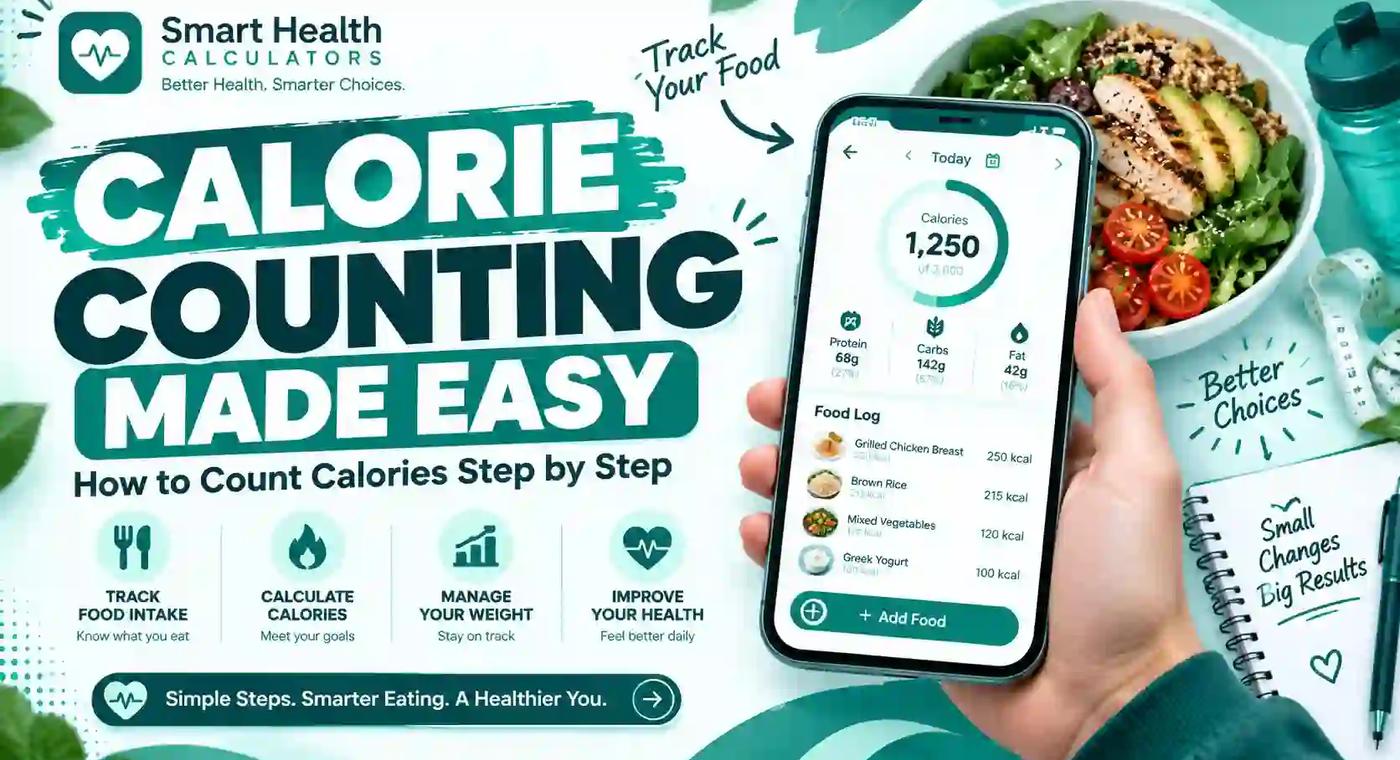
Calorie Counting Made Easy: How to Count Calories Step by Step
How to count calories simply and accurately. Find your daily calorie needs, read food labels, track home meals and restaurant food, and avoid common mistakes.
Most people don't quit calorie counting because it doesn't work. They quit because it feels like a second job. Weighing every grain of rice, scanning every barcode, and feeling guilty about a missed log by Wednesday afternoon wears anyone down.
It doesn't have to be that way. Calorie counting works best when it's built around a few simple habits instead of perfect data. This guide shows you how to estimate your daily calorie needs, read labels, handle homemade meals and restaurant food, and track without becoming obsessive.
You can also run your numbers while you read. The Calorie Intake Planner on Smart Health Calculators gives you a personalized starting point in under a minute.
What Is Calorie Counting?
Calorie counting is the practice of tracking the energy you get from food and drinks so you can compare it with the energy your body uses. If you eat fewer calories than you use, your weight tends to go down. If you eat about the same, it stays steady. If you eat more, it tends to go up.
The method is simple. Doing it consistently is the hard part, and that's what the rest of this guide addresses.
What Is Calorie Counting and How Does It Work?
A calorie is a unit of energy. When people say a snack has "200 calories," they usually mean kilocalories (kcal), the standard unit on food labels.
Your body gets calories from four sources, according to the FDA's explanation of calories on the Nutrition Facts label: carbohydrate, fat, protein, and alcohol.
| Energy source | Approximate calories per gram |
|---|---|
| Carbohydrate | 4 |
| Protein | 4 |
| Fat | 9 |
| Alcohol | 7 |
This table explains why oils, butter, and nuts pack so much energy into small portions. A tablespoon of cooking oil holds roughly 120 calories. A tablespoon of cooked rice holds about 20.
The energy balance idea
Calorie counting rests on energy balance, which compares energy intake (what you eat and drink) with energy expenditure (what your body burns).
Your body burns energy in three main ways:
- Basal metabolic rate (BMR): the energy needed to keep you alive at rest, such as breathing, circulation, and cell repair.
- Physical activity: workouts, walking, chores, and even fidgeting.
- Digesting food: a smaller portion of your daily burn.
Add these together and you get your total daily energy expenditure (TDEE), the number of calories you burn in a typical day. You can check your resting number with the BMR Calculator.
Why it isn't perfectly exact
Energy balance is a useful model, not a flawless equation. Your metabolism shifts as your weight changes. Food labels allow some margin of error. Your body doesn't absorb every food identically. That's why calorie counting works best as a feedback system: you estimate, watch the results, and adjust.
Why Calorie Counting Matters
Calorie counting builds awareness. Many people are surprised when they log a normal week of eating for the first time.
Here's what a few weeks of tracking can show you:
- Hidden calories in drinks, sauces, cooking oil, and "just a bite" snacking.
- Portion drift, where a serving slowly grows over time.
- Patterns, like eating more on weekends or late at night.
- Protein and fiber gaps that leave you hungry even when you've eaten enough calories.
According to the CDC's healthy weight guidance, being mindful of calories can help with weight management, as long as you also focus on nutritious food and regular physical activity. That framing matters. Calories are one tool inside a bigger picture of healthy eating, not a replacement for it.
Who benefits most
Calorie counting tends to help people who:
- Want to lose or maintain weight and need a clear structure.
- Feel they "eat healthy" but aren't seeing results.
- Are building muscle and need to eat enough.
- Want to understand how food portions translate into numbers.
Who should be careful
Calorie counting isn't right for everyone. Skip it, or talk to a professional first, if you:
- Have a history of disordered eating or feel anxious around food numbers.
- Are pregnant or breastfeeding.
- Are under 18.
- Have a medical condition that affects nutrition, such as diabetes or kidney disease.
The NIH Body Weight Planner is designed for adults 18 and older and isn't intended for pregnancy or breastfeeding. A registered dietitian or doctor can give you advice that fits your situation.
Step 1: Estimate Your Daily Calorie Needs
Before you count anything, you need a target. This is where many beginners go wrong by copying a number from the internet.
You may have seen 2,000 calories per day. The FDA uses it as a general reference for nutrition labeling, not a personal prescription. Your needs depend on:
- Age
- Sex
- Height
- Current weight
- Physical activity level
- Health status
The CDC also notes that calorie needs can be estimated from age, sex, height, weight, and activity level.
A simple way to find your number
- Find your BMR. Use the BMR Calculator to see what your body burns at rest.
- Adjust for activity. Multiply by an activity factor, or let a calculator do it. A desk job with little exercise sits near the low end. A job on your feet plus regular workouts sits higher.
- Get your maintenance calories. This is roughly what keeps your weight steady.
- Pick a goal. Lose, maintain, or gain.
The Calorie Intake Planner handles steps 2 through 4 for you.
A worked example
Take a 32-year-old woman who works at a desk and walks for 30 minutes most days. A calculator might estimate her maintenance at around 2,000 calories. If she wants to lose weight gradually, she might aim for about 1,600 to 1,750 calories per day, a modest reduction she can sustain.
Those numbers are illustrative. Her real target depends on her height, weight, and activity. Treat any calculator result as a starting estimate, then adjust based on what the scale and your energy levels tell you over 2 to 4 weeks.
For age-based reference ranges, see Calorie Intake for Men and Women by Age and Recommended Calorie Intake Per Day. The Dietary Guidelines for Americans also publish estimated calorie needs by age, sex, and activity level.
Step 2: Understand the Calorie Deficit (Without the Hype)
A calorie deficit means eating fewer calories than you burn. It's the basic mechanism behind weight loss.
You'll often hear that a pound of body fat equals about 3,500 calories. That rule of thumb is a rough guide. Real-world results vary because your metabolism adapts as you lose weight.
How big should your deficit be?
Smaller usually beats bigger. Very aggressive deficits tend to backfire. They can cause fatigue, constant hunger, muscle loss, and rebound overeating.
The CDC describes gradual weight loss of about 1 to 2 pounds per week as a commonly recommended pace. It also notes that losing even 5% to 10% of your body weight can bring health benefits. Verify these figures against the current CDC page before relying on them, since guidance gets updated.
A practical approach:
- Start with a moderate deficit, not an extreme one.
- Keep protein and fiber high so you stay full.
- Don't go very low in calories without medical supervision.
- Reassess every few weeks.
If you're curious how deficit differs from simply burning more through exercise, read Calorie Intake vs Calories Burned.
Step 3: Learn to Read a Nutrition Facts Label
Labels are your most reliable everyday data source for packaged food. The FDA's guide to the Nutrition Facts label is a good reference. Here are the habits that matter most.
Check the serving size first
The calorie number at the top applies to one serving, not the whole package. This is the most common label mistake.
Example: A bag of crackers lists 140 calories per serving and says it contains 3 servings. If you eat the whole bag, you've eaten 420 calories, not 140.
Look at "servings per container"
Always do the multiplication:
Calories per serving × servings you ate = calories consumed
Use calories as a guide, not the whole story
Calories tell you how much energy a food has. They don't tell you how filling or nutritious it is. Scan the rest of the label for:
- Protein and fiber, which support fullness.
- Added sugars, which add calories without much else.
- Sodium, if you're watching blood pressure.
Serving size vs. portion size
These terms get mixed up constantly.
- Serving size is a standardized amount listed on a label.
- Portion size is the amount you actually put on your plate.
Your portion can be half a serving or three servings. Calorie counting is mostly the art of noticing the difference.
Step 4: Choose a Tracking Method That Fits Your Life
The best method is the one you'll actually keep using. Here's how the main options compare.
| Method | Best for | Main drawback |
|---|---|---|
| Calorie tracking app | Convenience, large food databases | Entries can be inaccurate or duplicated |
| Food diary (notebook) | People who dislike screens | Manual math takes time |
| Spreadsheet | Data lovers who want control | Setup effort |
| Photo logging | Quick tracking, no numbers at first | Needs review later |
| Portion-based tracking (hands, plates) | Beginners who want low effort | Less precise |
How accurate are calorie tracking apps?
Apps are useful but imperfect. Many databases include user-submitted entries, which can contain errors. For better accuracy:
- Prefer entries marked as verified or sourced from official databases.
- Cross-check unusual entries with the USDA FoodData Central database.
- Pick one entry per food and reuse it, so your logging stays consistent.
Consistency matters more than precision. If your estimates are 10% off in the same direction every day, your results will still be predictable and you can adjust accordingly.
Do you need a food scale?
A food scale is the most accurate tool, but you don't need one to start. Many people use a scale for a couple of weeks to calibrate their eyes, then switch to measuring cups and visual estimates.
Step 5: Estimate Portions Without a Scale
If you don't want to weigh food, your hand is a handy ruler. These are approximations, but they work well for everyday tracking.
- Palm (without fingers): about one serving of cooked meat, fish, or chicken.
- Cupped hand: about one serving of cooked rice, pasta, or grains.
- Fist: about one cup of fruit, vegetables, or cereal.
- Thumb: about one tablespoon of oil, butter, or nut butter.
- Thumb tip: about one teaspoon.
Keep in mind that hands vary in size, so use these as a rough baseline.
Quick plate method
For a no-math approach, the MyPlate guidance from the USDA suggests building meals around vegetables, fruits, grains, protein, and dairy. Fill about half your plate with vegetables and fruits, a quarter with protein, and a quarter with grains. This method naturally steers you toward balanced calories without tracking every number.
Step 6: Count Calories in Homemade Meals
Home cooking is where tracking feels hardest, because there's no label. Here's a simple system.
The recipe method
- List every ingredient with its raw amount (including oil, ghee, and butter).
- Log the total calories for the whole pot.
- Divide by the number of servings. For example, if you split the dish into 4 equal bowls, each gets one quarter.
A practical example
Say you make a chicken and vegetable curry:
- 500 g chicken breast: about 825 calories
- 2 tablespoons oil: about 240 calories
- Onions, tomatoes, and spices: about 100 calories
- 1 cup yogurt: about 150 calories
The total is roughly 1,315 calories. If the pot makes 5 servings, each serving is about 263 calories, before rice or roti.
Those are estimates, and ingredient calories vary by brand and cut. They're close enough to build good habits.
Don't forget the add-ons
Items like roti, rice, and chutneys count. A medium homemade roti is often around 100 to 120 calories, depending on size and whether it has ghee. Rice portions vary a lot, so use your cupped hand or a measuring cup.
Tip for family meals
If you cook for the whole family, plate your portion first and log it. You don't need to cook separate meals. You only need to know how much of the shared dish landed on your plate.
For meal inspiration that fits your calorie target, try the Diet Plan Generator.
Step 7: Count Calories When Eating Out
Restaurant food is calorie-dense. Portions are generous, and cooking often involves extra oil, butter, or cream.
Here's how to stay on track without turning dinner into a math exam.
- Check nutrition info online before you go. Many chains publish it.
- Choose a close match in your app if the dish isn't listed. Pick a similar item from the same type of cuisine.
- Add a buffer of 10% to 20% for hidden oil and larger portions.
- Ask for sauces and dressings on the side.
- Share a dessert or starter instead of skipping them.
- Eat slowly and stop when you're comfortably full.
Restaurant meals can easily run higher than home-cooked versions of the same dish. That's normal. Log your best estimate, enjoy the meal, and move on.
The Calories People Forget to Count
Most tracking gaps come from small, easy-to-miss items. Watch for these:
- Cooking oil and ghee. A tablespoon is about 120 calories, and it's easy to pour more than you think.
- Sauces, dressings, and mayo. Two tablespoons of creamy dressing can add 100 to 160 calories.
- Drinks. Sweet tea, juice, soda, milky coffee, and smoothies count. Alcohol adds calories too.
- Bites and tastes while cooking or finishing a child's plate.
- Nuts and trail mix. Healthy, but dense. A small handful can reach 170 to 200 calories.
Hydration helps here too. Drinking water instead of sugary drinks is an easy swap. See Hydration and Weight Loss and use the Water Intake Calculator to find a daily target.
The 3 Golden Rules of Easy Calorie Counting
If you take nothing else from this guide, take these.
Rule 1: Aim for "close enough," not perfect
You don't need exact numbers. A reasonable estimate logged consistently beats a perfect entry you skip because it's too much effort.
Rule 2: Track the big wins first
Start by logging the highest-impact items: main meals, oils, drinks, and snacks. Once that feels easy, add detail.
Rule 3: Prioritize protein and fiber
These two nutrients help you feel full on fewer calories. Protein needs vary by weight, age, and activity, so check How Much Protein Do I Need Per Day to find a sensible range. If you're also building muscle, the Muscle Gain Diet Plan shows how to adjust.
Calorie Counting Plans for Different Lifestyles
For busy professionals
Log your meals in batches rather than in the moment. Take a quick photo of each meal, then enter them all during a 5-minute window at night. Meal prep on Sunday and log the recipe once.
For students on a budget
Build a short list of 8 to 10 cheap, repeatable meals, such as lentils with rice, eggs with toast, or oats with banana. Log them once and reuse the entries.
For people building muscle
Use calorie tracking to make sure you're eating enough, not too little. Aim for a slight surplus, high protein, and consistent training. The Workout Planner helps you pair your nutrition with a training schedule.
For people eating mostly traditional or home-style meals
If you eat dishes like daal, sabzi, roti, rice, and biryani, build your own mini food database. Weigh your usual plate once, log it as a saved meal, and reuse it. Regional foods are often missing or inaccurate in apps, so your own entries will serve you better.
Why Am I Counting Calories but Not Losing Weight?
This is one of the most common frustrations, and it usually comes down to a handful of causes.
- Underestimating portions. Studies on self-reported intake often find people underreport what they eat.
- Forgetting liquid calories and small bites.
- Overestimating exercise burn. Fitness trackers can overshoot calorie estimates.
- Weekend swings. A strict Monday through Friday can be undone by two high-calorie days.
- Too short a timeframe. Water retention, hormones, and sodium can hide fat loss for a week or two.
- A target that's too high. Recalculate as your weight changes.
If you've been consistent for 3 to 4 weeks with no change, review your logging for accuracy before cutting calories further. For a deeper troubleshooting list, read Why Your Diet Is Not Working.
How to Count Calories Without Getting Obsessive
Tracking should support your life, not take it over. Watch for warning signs like:
- Feeling intense guilt after going over your target.
- Skipping social events because you can't log the food.
- Eating very little to "save" calories.
- Feeling anxious when you can't track.
If this sounds familiar, take a break from numbers. Switch to portion-based eating or a plate method for a while. If your relationship with food feels distressing, speak with a qualified health professional.
Habits that keep tracking healthy
- Use a weekly average, not a strict daily limit. One high day doesn't undo your progress.
- Allow a calorie range (for example, 1,600 to 1,800) instead of a single number.
- Plan flexibility for events, holidays, and travel.
- Combine tracking with other health habits like sleep, steps, and strength training.
Movement matters, but you don't need extreme workouts. The Step Counter Goal Planner helps you set a realistic daily step goal. The CDC suggests that most adults aim for at least 150 minutes of moderate-intensity aerobic activity per week, plus muscle-strengthening activity on at least 2 days. Check the CDC's physical activity guidelines for the current wording.
What If You Go Over Your Calorie Goal?
Nothing dramatic happens. One higher-calorie day doesn't ruin your progress, and your body doesn't store a single meal as instant fat.
Here's what to do instead of panicking:
- Log it honestly. Skipping the entry hides useful information.
- Return to your normal plan at the next meal. Don't "punish" yourself with a very low-calorie day.
- Look at your weekly average to see the real picture.
- Ask what happened. Were you hungry, bored, stressed, or just enjoying a celebration? The answer helps you plan ahead.
Calorie Counting vs. Other Approaches
Calorie counting isn't the only way to manage your eating. Here's how it compares.
Calorie counting vs. intuitive eating
Calorie counting gives you numbers and structure. Intuitive eating relies on hunger and fullness cues. Counting can work well for specific goals and for learning portions. Intuitive eating can work well for people who find numbers stressful. Many people combine the two: they count for a few months to build awareness, then shift to more intuitive habits.
Calorie counting vs. portion control
Portion control uses visual guides and doesn't require logging. It's simpler but less precise. It's a good middle ground if full tracking feels like too much.
Calorie counting vs. macro tracking
Macro tracking follows protein, carbohydrate, and fat targets, not just calories. It's useful for athletes and muscle-building goals. Beginners usually do better starting with calories and adding protein as a second focus.
Calorie counting vs. meal planning
Meal planning decides what you'll eat in advance. Combined with calorie counting, it removes daily guesswork. A tool like the Diet Plan Generator can build a plan around your calorie target.
How Long Should You Count Calories?
You don't need to count forever. A common approach looks like this:
- First 2 to 4 weeks: Track closely to learn your portions and habits.
- Next few months: Track regularly or a few days a week to stay accurate.
- Maintenance phase: Check in occasionally, such as one week every month, or track only when your weight starts to drift.
The goal is to build skills so that you rely less on logging over time. Many people find that after a few months, they can estimate their meals with surprising accuracy.
Maintaining weight after you stop tracking
- Keep a few anchor habits, like consistent protein at breakfast and mindful portions.
- Weigh yourself weekly or monthly to catch small changes early.
- Stay active.
- Return to short tracking periods if the scale creeps up.
Calorie Counting and Body Measurements
The scale isn't the only metric. Weight can fluctuate by a pound or two daily from water, salt, and digestion. Consider tracking:
- Waist circumference
- How your clothes fit
- Energy levels and sleep
- Strength and endurance
Tools like the BMI Calculator and Body Fat Estimator provide extra context, though no single number tells the full story. To understand the limits of BMI, read Is BMI Accurate? Limitations Explained, and see the Healthy BMI Range guide for reference ranges. If your goal is fat loss specifically, the Natural Body Fat Reduction Guide goes deeper.
Why Choose Smart Health Calculators
Tracking calories is easier when your tools work together. Here's why Smart Health Calculators is built for beginners and experienced users alike:
- Free, simple tools that give you results in seconds.
- Connected calculators: BMR, calorie intake, water, steps, workouts, and diet planning in one place.
- Plain-language articles that explain what your numbers mean.
- No clutter, so you can focus on your goal.
If you want to learn more about who's behind the platform, visit the About page. Have a question or suggestion? You can contact the team. To see how different tools compare, read about the best free health calculators.
Explore Advanced Tools at Smart Health Calculators to build a complete plan that covers nutrition, hydration, activity, and sleep.
Real-World Example: A 4-Week Calorie Counting Plan
Here's how a beginner might apply everything in this guide.
Week 1: Observe
Log everything you eat without trying to change it. Use your app or notebook. Note your usual portions, snacks, and drinks.
Week 2: Set your target
Use the Calorie Intake Planner and BMR Calculator to find your range. Start with a modest deficit if weight loss is your goal.
Week 3: Adjust the biggest levers
Swap sugary drinks for water or unsweetened tea. Measure cooking oil. Add protein to breakfast.
Week 4: Review and refine
Compare your weekly average calories with your target. Check your weight trend, energy, and hunger. Adjust your target by a small amount if needed.
By the end of month one, you'll know your habits, your portions, and your real numbers, which is more valuable than any perfect plan.
Frequently Asked Questions
What is calorie counting?
Calorie counting is the practice of tracking the calories in the food and drinks you consume to manage your weight. By comparing your intake with your estimated daily energy needs, you can aim to lose, maintain, or gain weight.
How many calories do I need each day?
It depends on your age, sex, height, weight, and activity level. There's no single number that fits everyone. Use a tool like the Calorie Intake Planner for a personalized estimate, and see the NIH Body Weight Planner for another reference if you're an adult.
Is calorie counting effective for weight loss?
It can be. Tracking helps many people become aware of portions and create a calorie deficit. Results depend on consistency, accuracy, and overall food quality. Calorie counting works best alongside physical activity and balanced nutrition, and it isn't the best fit for everyone.
Do I need a food scale to count calories?
No. A scale improves accuracy, but you can use measuring cups, hand portions, or the plate method. Many people use a scale briefly to learn portion sizes, then rely on estimates.
How accurate are calorie tracking apps?
Apps give useful estimates, but they aren't perfectly accurate. Database entries can be wrong, and food labels allow some variation. Choose verified entries, stay consistent, and treat your total as an estimate rather than an exact measurement.
Is calorie counting safe for everyone?
No. People with a history of eating disorders, children and teens, pregnant or breastfeeding women, and people with certain medical conditions should talk to a doctor or registered dietitian before counting calories or cutting back on food.
Conclusion:
Calorie counting is not about perfection. It's about awareness, consistency, and small adjustments that add up over time.
Here are your next steps:
- Find your starting number with the Calorie Intake Planner.
- Pick one tracking method and use it for two weeks.
- Learn to read labels and measure the foods that matter most.
- Review weekly, adjust gently, and keep your goal realistic.
- Pair your nutrition with movement, water, and sleep for lasting results.
Ready to go further? Book a seat at Advance Free Tools offered by Smart Health Calculators and explore the full tools collection to turn these steps into a plan that works for you.
Medical Disclaimer
This article is for general education only. It is not medical advice, diagnosis, treatment, prescription guidance, or a replacement for professional healthcare. Speak with a qualified healthcare professional for personal medical concerns, symptoms, pregnancy concerns, mental health crisis, medication questions, or before making major health changes.