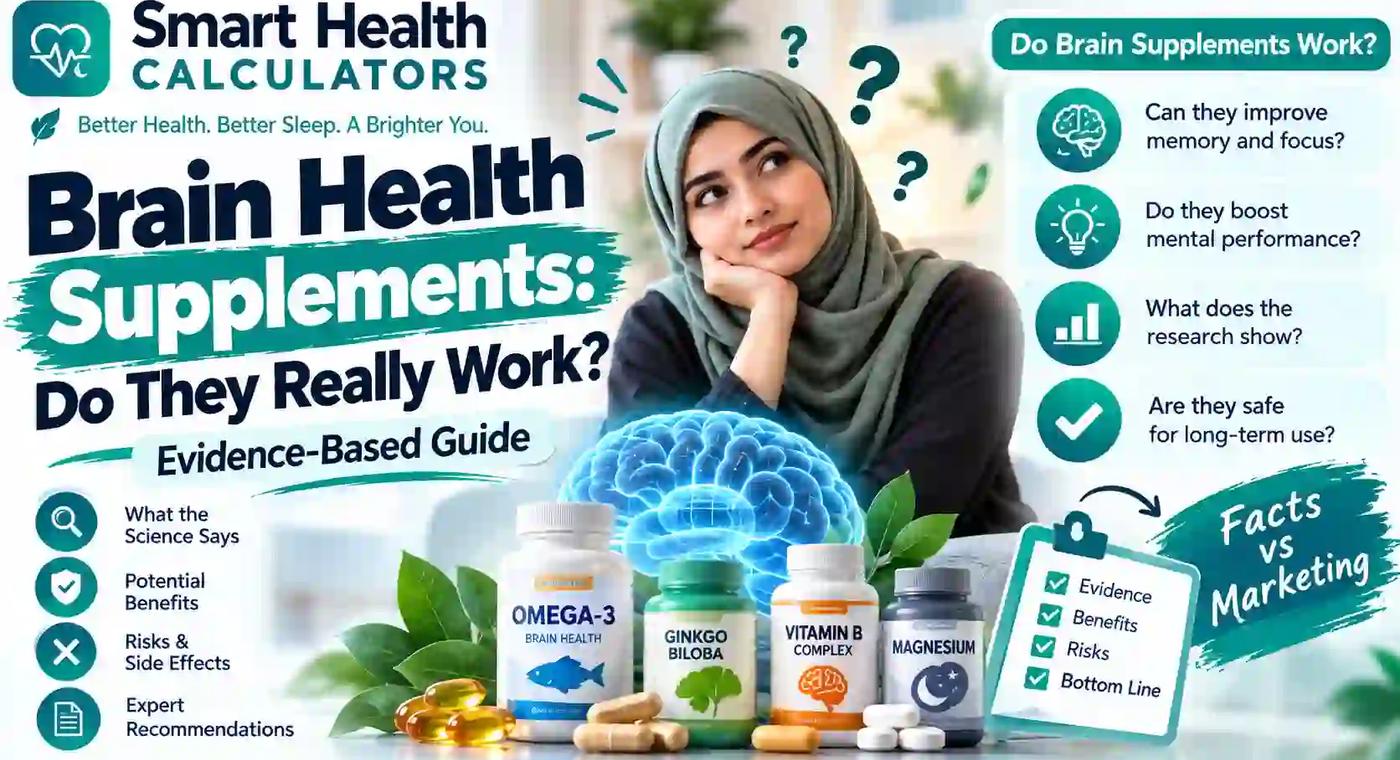
Brain Health Supplements: Do They Really Work? Evidence-Based Guide
Learn whether brain health supplements really work, what research says about ginkgo, omega-3s, vitamin E, B vitamins, and curcumin, and key safety tips.
Walk down any pharmacy aisle and you'll see them: bottles promising sharper memory, "clinically proven" cognitive support, formulas with names like Neuro-something or Brain-anything. The brain health supplement market has grown into a multi-billion-dollar industry built almost entirely on hope — and a surprisingly thin evidence base.
This isn't an article claiming every brain supplement is a scam or that nothing in a capsule could ever help your brain. The honest, evidence-based position is more specific than that: marketing claims about brain-health supplements routinely go further than what clinical research currently supports. Understanding exactly where that gap lies — which ingredients have been studied, what those studies actually found, and how supplement marketing gets away with vague promises — is what separates an informed buyer from someone paying premium prices for a bottle of hope.
What "Brain Health Supplements" Actually Means
The category is broad. It includes single-ingredient products like ginkgo biloba capsules, fish oil pills marketed for omega-3s, B-vitamin complexes, and curcumin extracts, as well as branded "nootropic" blends that combine a dozen ingredients under one label with names like Alpha Brain, Prevagen, or Mind Lab Pro.
What they share is the marketing pitch: improved memory, sharper focus, protection against age-related cognitive decline, or reduced risk of dementia. What they often don't share is a body of randomized, placebo-controlled clinical trials confirming those specific claims in healthy people.
It helps to separate two very different questions before buying anything:
- Does this ingredient do something measurable in the body? (Often yes, at least in a lab or in specific deficiency states.)
- Does taking this supplement meaningfully improve memory, focus, or dementia risk in an otherwise healthy adult? (Usually the evidence is thin, mixed, or absent.)
Supplement marketing tends to blur these two questions together. A product can be technically accurate about an ingredient's biological role while still implying a cognitive benefit that hasn't been demonstrated in actual human trials.
What the Research Actually Says About Popular Ingredients
This is where things get specific, because "the evidence is mixed" means something different for each ingredient.
Ginkgo Biloba
Ginkgo is probably the most heavily marketed and most rigorously tested brain supplement on the market, which makes it a useful case study. The National Center for Complementary and Integrative Health (NCCIH) is direct about this: there's no conclusive evidence that ginkgo biloba can prevent or slow dementia or cognitive decline.
The strongest piece of evidence here isn't a small industry-funded study — it's a large, NIH-funded trial. An NCCIH-funded study of the well-characterized ginkgo supplement EGb-761 recruited more than 3,000 volunteers aged 75 and older who took 240 mg of ginkgo daily and were followed for roughly six years, finding that it did not lower the incidence of dementia, including Alzheimer's disease, and did not slow cognitive decline. That's about as close to a definitive real-world answer as supplement research gets, and the answer was negative.
Some smaller meta-analyses, mostly involving people already diagnosed with Alzheimer's disease, have found modest improvements in cognitive scores at specific doses — but even those findings are inconsistent across studies and don't apply to healthy adults hoping to prevent decline before it starts.
Omega-3 Fatty Acids
This is the ingredient with the most genuinely interesting split between dietary intake and supplement form. Among the nutritional and dietary factors studied to prevent cognitive decline in older adults, the most consistent positive research findings are for omega-3 fatty acids, often measured as how much fish is consumed in the diet.
But that finding is about eating fish, not about swallowing a fish oil capsule. Omega-3s in supplement form have not been shown to be helpful in treating Alzheimer's disease, and separate research on healthy older adults found that taking omega-3 supplements did not have any beneficial effects on the cognitive functioning of older people without dementia.
This distinction matters enormously and rarely makes it into supplement advertising. A bottle of fish oil capsules is not nutritionally identical to a diet that regularly includes fatty fish — the food matrix, the accompanying nutrients, and possibly the overall dietary pattern all seem to play a role that an isolated capsule doesn't replicate.
Vitamin E
The evidence here is genuinely more nuanced than most articles let on. Only a small number of studies in people have looked at the effect of vitamin E in the prevention or treatment of Alzheimer's disease, and most findings have been negative, but moderate-quality evidence from a single study suggests vitamin E may slow functional decline in people who already have Alzheimer's disease.
That's an important distinction: potential benefit in people who already have the disease, not evidence that it prevents healthy people from developing it. A large prevention trial, PREADVISE, specifically tested whether vitamin E and selenium could prevent Alzheimer's in healthy older men — and found neither supplement prevented dementia. Vitamin E is also not risk-free in high doses, which is one more reason "natural" doesn't automatically mean "safe to take indefinitely."
B Vitamins (B6, B12, Folic Acid)
These get marketed heavily around a real biological mechanism — high homocysteine levels have been linked to cognitive decline, and B vitamins lower homocysteine. It's a plausible story. The trial results, though, have been disappointing. Results of short-term studies suggest that B-vitamin supplements do not help cognitive functioning in adults age 50 or older, with or without dementia, whether taken alone or in combination.
There's an important caveat worth stating clearly: if someone has an actual B12 deficiency — which becomes more common with age, certain medications, and some diets — correcting that deficiency can meaningfully help cognitive symptoms caused by the deficiency itself. That's a real medical intervention for a diagnosed problem, not a general brain-boosting strategy for someone with normal B12 levels.
Curcumin
Turmeric's active compound gets a lot of buzz for its anti-inflammatory properties, but the human cognitive evidence hasn't caught up to the marketing. The evidence on curcumin is too limited and inconsistent for any conclusions to be reached. That's a fair, honest summary — not "it doesn't work," but "we genuinely don't know yet," which is a very different message than what curcumin supplement labels typically imply.
Why "No Strong Evidence" Doesn't Mean "Definitely Useless"
It's worth being precise here, because sloppy language cuts both ways. Currently, there is no strong evidence that any complementary health approach can prevent cognitive impairment, according to NCCIH's broader review of the research on Alzheimer's prevention strategies.
That's different from saying every one of these ingredients has been proven useless. Some trials show modest positive signals; research on some approaches is ongoing; and correcting an actual nutrient deficiency is a legitimate use case that's entirely different from taking a supplement speculatively while already well-nourished. The responsible summary is that the burden of proof supplement marketers imply has been met — "clinically shown to support memory," "backed by science" — is usually a stretch relative to what the actual trials found.
How Supplement Marketing Gets Away With Vague Claims
This is the part most consumers never learn, and it explains a lot about why brain supplement labels sound so confident while the science underneath is so shaky.
The Federal Food, Drug, and Cosmetic Act requires a company marketing a dietary supplement with certain claims to notify FDA about the claim within 30 days after first marketing the product with that claim. This is a notification, not an approval process. Nobody at FDA reviews the science and signs off before the product hits shelves.
These are called structure/function claims — statements like "supports memory" or "promotes brain health." For a company to legally make this kind of claim, the entity making it must have substantiation that the statement is truthful and not misleading, the statement must be accompanied by a standard disclaimer stating that it hasn't been evaluated by the FDA and the product isn't intended to diagnose, treat, cure, or prevent any disease, and the claim must not assert that it treats or prevents a specific disease.
Read that disclaimer text again next time you see it on a supplement bottle: "This statement has not been evaluated by the Food and Drug Administration." That's not boilerplate legal filler — it's the government's way of saying nobody independently checked whether the claim is true. The company self-certifies that it has evidence, but that evidence isn't reviewed before the product is sold.
This is the legal mechanism that lets a bottle say "supports cognitive function" without a single human clinical trial behind that specific product — as long as it doesn't cross the line into claiming to treat or prevent Alzheimer's disease specifically, which would push it into drug-claim territory and trigger a completely different, far stricter regulatory pathway.
Red Flags to Watch For on a Supplement Label
Once you understand the regulatory gap above, certain marketing patterns become easy to spot:
- "Clinically proven" without a citation you can actually check. A specific, named, peer-reviewed study is verifiable. A vague reference to "clinical studies" with no citation is not.
- Proprietary blends that hide exact dosages. If a label lists a "Focus Blend" with six ingredients but doesn't break down the milligram amount of each, you can't compare it to the doses actually used in research studies — which matters, since dose is often exactly where a supplement's real-world effect falls apart.
- Testimonials standing in for trial data. Personal stories are not evidence of efficacy; they're marketing.
- Claims that stack multiple weak ingredients as if effects add up. Combining five ingredients each with inconclusive individual evidence doesn't create strong combined evidence — it usually just means five inconclusive things in one capsule.
- Any implication that a supplement can prevent or reverse Alzheimer's disease. No supplement has cleared that bar in rigorous human trials, and that specific claim should be treated as an immediate credibility red flag regardless of which ingredient is being marketed.
Are Brain Supplements Safe to Take?
"Natural" doesn't automatically mean risk-free, and this is where the safety conversation deserves as much attention as the effectiveness conversation.
Drug interactions are a genuine concern, not a hypothetical one. Ginkgo, for instance, has documented interactions with blood thinners, and combining supplements without medical guidance is one of the more common ways people run into unexpected side effects. Because dietary supplements don't go through the same premarket safety review as prescription medications, the responsibility for flagging interactions falls much more heavily on the consumer and their doctor than most people realize.
Dosage isn't standardized the way it is for medications. Two bottles of "ginkgo extract" from different manufacturers can vary meaningfully in actual active-ingredient content, since manufacturing quality and third-party testing aren't uniformly enforced across the industry.
High-dose antioxidant supplementation isn't automatically protective, despite the intuitive "antioxidants fight free radicals, free radicals damage the brain" logic. Some large trials of high-dose vitamin E and other antioxidants have found no benefit and, in certain contexts, potential downsides at high doses over long periods.
If you're taking any prescription medication, are pregnant, or have an existing health condition, talking to a doctor or pharmacist before adding a brain supplement isn't overly cautious — it's the step that actually catches the interactions and dosage issues that supplement labels won't flag for you.
What Actually Has Stronger Evidence Than a Capsule
Here's the more useful — and less commercially exciting — part of this conversation. If the goal is genuinely supporting brain health as you age, several lifestyle factors have considerably more consistent research behind them than most supplements on the market.
Quality sleep plays a measurable role in memory consolidation and clearing metabolic waste from the brain overnight. If your sleep quality has been inconsistent, running through our Sleep Quality Checker is a more concrete first step than reaching for a supplement, and our breakdown of how stress affects sleep quality covers one of the most common reasons sleep quality slips in the first place.
Chronic stress management has real, measurable effects on cognitive function over time, largely through its impact on sleep, inflammation, and hormone regulation. Our guide on natural ways to reduce stress and the 5-minute breathing exercises to lower your stress score are both practical starting points, and you can get a baseline read on where you currently stand using our Mental Health Checker.
Regular physical activity is one of the more consistently supported modifiable factors linked to cognitive health across large population studies — considerably more consistently than any single supplement discussed above. If structured movement isn't already part of your routine, our Workout Planner can help build something sustainable.
Diet quality, particularly dietary patterns like the Mediterranean and MIND diets that emphasize fish, vegetables, nuts, and whole grains, has a more consistent research base for cognitive health than isolated supplement pills — which loops back to the omega-3 example above, where the fish itself outperformed the capsule in the research. Our Diet Plan Generator can help translate that into an actual weekly structure, and our guide on how much protein you actually need per day covers a related nutritional basic worth getting right.
Cardiovascular and metabolic health connect directly to brain health, since the brain depends heavily on healthy blood flow. Tracking broader indicators of aging and health through our Health Age Calculator and reading through habits that help lower your biological age gives a more holistic picture than any single supplement claim can offer.
Consistent routines and self-reflection matter more than people expect. Our piece on journaling for mental health and self-awareness and the mental health self check-in guide both support the kind of ongoing self-monitoring that catches cognitive or mood changes early — often far earlier than waiting for a supplement to "kick in."
None of this is as fast or as marketable as a bottle with a bold claim on the label. But it's also the set of interventions actually reflected in the research NCCIH and NIA point to when discussing what's known about supporting cognitive health with age.
How to Evaluate Any Brain Supplement Before Buying
If you're still considering a specific product, run it through this checklist rather than the marketing copy:
- Look up the specific ingredient on NCCIH or PubMed, not just the brand's own website, and see what the actual trials found — not the brand's summary of them.
- Check whether the dose in the product matches doses used in actual clinical trials. A product using a fraction of the tested dose can't reasonably claim the same effect.
- Read the disclaimer. If it says the statement hasn't been evaluated by the FDA, treat the accompanying claim as unverified marketing language, not established fact.
- Ask whether you have an actual diagnosed deficiency (like low B12) that a supplement would correct, versus taking it speculatively while already adequately nourished — these are very different use cases with very different expected benefits.
- Talk to your doctor or pharmacist, especially if you take any prescription medication, since interaction risk is one of the most under-discussed parts of this entire category.
Frequently Asked Questions
Do brain health supplements actually work?
The evidence varies significantly by ingredient, but for most widely marketed products — including ginkgo, omega-3 supplements, and B vitamins — clinical trials in healthy adults have not shown the memory or cognitive benefits implied by marketing claims.
Can vitamins prevent dementia or Alzheimer's disease?
No vitamin or supplement has been proven to prevent Alzheimer's disease or dementia. Research continues, and some studies show modest effects in specific circumstances, but no product has cleared the bar of reliable, repeated evidence in large human trials.
Is ginkgo biloba good for memory?
A large, NIH-funded trial following more than 3,000 older adults for roughly six years found that ginkgo did not lower dementia incidence or slow cognitive decline, making the "conclusive proof" marketing claims around ginkgo inconsistent with the strongest available evidence.
Are omega-3 supplements as good as eating fish for brain health?
Not based on current evidence. Dietary fish intake shows more consistent associations with cognitive benefits than omega-3 supplements, which have not shown convincing benefits for treating or preventing cognitive decline in clinical trials.
Does the FDA approve brain supplements before they're sold?
No. Dietary supplement companies notify the FDA about certain marketing claims, but the FDA does not pre-approve dietary supplements for safety or effectiveness the way it does prescription medications, and the required disclaimer on supplement labels reflects exactly that gap.
Are brain supplements dangerous to take?
Not necessarily, but they aren't automatically risk-free either. Some ingredients, including ginkgo, carry documented interaction risks with certain medications, and dosages aren't standardized across manufacturers the way prescription drug doses are — so checking with a doctor before combining supplements with existing medications is a reasonable precaution.
CONCLUSION
The strongest, most consistent research on protecting cognitive function as you age doesn't point to a supplement aisle — it points to sleep, movement, stress management, cardiovascular health, and dietary patterns built around real food rather than isolated capsules. That's a less exciting answer than a bottle promising sharper focus by next week, but it's the answer that actually holds up against the clinical trials.
Before spending money on the next heavily marketed brain supplement, spend five minutes checking your actual foundations instead: run a quick check with our Sleep Quality Checker or Mental Health Checker, and build a realistic plan using our Workout Planner or Diet Plan Generator. Those cost nothing to try and are backed by considerably more consistent evidence than most of what's sold in a capsule.
Medical Disclaimer
This article is for general education only. It is not medical advice, diagnosis, treatment, prescription guidance, or a replacement for professional healthcare. Speak with a qualified healthcare professional for personal medical concerns, symptoms, pregnancy concerns, mental health crisis, medication questions, or before making major health changes.