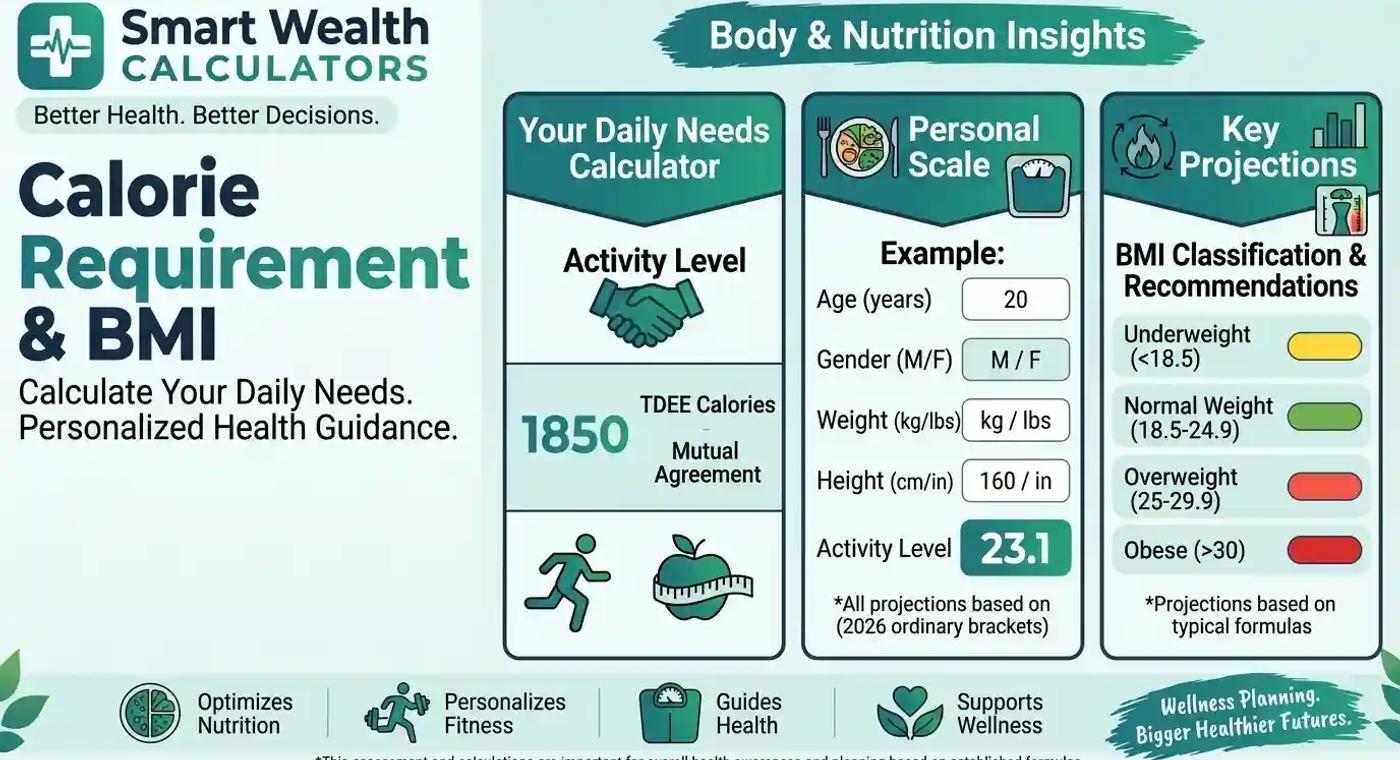
Calorie Requirement & BMI: Calculate Your Daily Needs
Calorie requirement and BMI explained. See how BMI relates to daily calorie needs and calculate your maintenance, loss, and gain calories.
Here's the honest answer: BMI doesn't set your calorie requirement. It's a screening tool for body size. Your calorie needs depend on your age, sex, height, weight, and how much you move. BMI becomes useful when you pair it with those factors and with your goal, whether that's losing, maintaining, or gaining weight.
This guide shows you how the two connect, how to calculate your own daily calorie needs step by step, and where both numbers can mislead you. Every example includes the math, so you can follow along with your own figures.
This article is general education, not medical advice. If you have a health condition, are pregnant, or take medication, talk to a doctor or registered dietitian before changing your intake.
How Many Calories Do I Need Based on My BMI?
BMI alone can't tell you how many calories to eat. Calorie requirements depend on age, sex, height, weight, and physical activity. Most adults need roughly 1,600 to 3,000 calories a day to maintain their weight, with the exact number varying widely from person to person.
The most reliable way to estimate your needs:
- Calculate your BMI to see where your weight falls.
- Estimate your BMR (calories your body burns at rest).
- Multiply by an activity factor to get your TDEE (total daily energy expenditure).
- Adjust for your goal: eat a modest deficit to lose weight or a modest surplus to gain.
You can do all of this with the free BMI Calculator, BMR Calculator, and Calorie Intake Planner.
What Is BMI, and What Does It Actually Measure?
Body mass index (BMI) is a ratio of your weight to your height. It's a quick screening measure, not a diagnosis, and it doesn't directly measure body fat.
BMI formula (metric): weight in kilograms ÷ height in meters squared
BMI formula (imperial): 703 × weight in pounds ÷ height in inches squared
Adult BMI Categories
The CDC's adult BMI categories are:
| BMI Category Below 18.5 Underweight 18.5 – 24.9 Healthy weight 25.0 – 29.9 Overweight 30.0 and above Obesity | Category |
|---|---|
| Below 18.5 | Underweight |
| 18.5 – 24.9 | Healthy weight |
| 25.0 – 29.9 | Overweight |
| 30.0 and above | Obesity |
The World Health Organization uses the same standard adult thresholds. These apply to adults 20 and older. Children and teens use age- and sex-specific percentiles instead, so don't apply adult categories to them.
For a deeper look, read our guides on what BMI is and why it matters and the healthy BMI range. Want to see how height changes the range? Check the normal weight range by height guide.
What Is a Calorie Requirement?
Your calorie requirement is the amount of energy from food and drink you need each day to support your body and activity. Eat the same amount you burn, and your weight stays steady. Eat more, and you gain. Eat less, and you lose over time.
This idea is called energy balance, and it's the foundation of weight management. It sounds simple, but real bodies add complications, which we'll cover.
The Key Terms You Need
- Basal metabolic rate (BMR): The calories your body burns at complete rest to run your heart, lungs, brain, and other organs.
- Resting metabolic rate (RMR): Very similar to BMR, measured under slightly less strict conditions.
- Thermic effect of food: Energy used to digest and process what you eat, roughly 10% of intake.
- Physical activity level (PAL): How much you move beyond resting.
- Total daily energy expenditure (TDEE): BMR plus activity plus digestion. This is your maintenance calories.
In short: TDEE is your calorie requirement for staying at your current weight.
How BMI and Calorie Needs Are Connected
BMI and calories describe different things, but they tell a story together.
- BMI describes where your weight sits relative to your height.
- Calorie requirement describes how much energy your body uses.
A larger body generally burns more energy at rest, so higher body weight usually means a higher BMR. But two people with the same BMI can need very different calories because of age, sex, muscle mass, and activity.
Why BMI Alone Misleads Calorie Planning
Consider two adults, both with a BMI of 25.
- One is a sedentary office worker with little muscle.
- The other is a recreational weightlifter with more muscle mass.
Their BMI matches, but the lifter likely burns more calories at rest and during exercise. Using BMI alone would give both the same advice, which would be wrong for at least one of them.
The NIDDK notes that BMI does not directly measure body fat and can be less informative for some people, including highly muscular individuals. That's why serious calorie planning uses weight, height, age, sex, and activity.
How BMI Is Still Useful
BMI helps you:
- Spot whether weight loss, maintenance, or gain is a sensible goal.
- Track broad changes over time.
- Start a conversation with a healthcare provider.
Treat it as a starting point, not a verdict.
Step-by-Step: How to Calculate Your Daily Calorie Needs
Here's a manual method you can run with a calculator.
Step 1: Calculate Your BMI
Use the formula above or the BMI Calculator.
Step 2: Estimate Your BMR With the Mifflin-St Jeor Equation
This widely used formula estimates resting calorie burn.
- Men: BMR = (10 × weight in kg) + (6.25 × height in cm) − (5 × age) + 5
- Women: BMR = (10 × weight in kg) + (6.25 × height in cm) − (5 × age) − 161
Skip the arithmetic with the BMR Calculator.
Step 3: Multiply by Your Activity Factor
| Activity level | Description | Multiplier |
|---|---|---|
| Sedentary | Desk job, little exercise | 1.2 |
| Lightly active | Light exercise 1–3 days a week | 1.375 |
| Moderately active | Moderate exercise 3–5 days a week | 1.55 |
| Extra active | Physical job plus intense training | 1.9 |
Step 4: Adjust for Your Goal
- Maintain weight: Eat around your TDEE.
- Lose weight: Eat modestly below TDEE.
- Gain weight: Eat modestly above TDEE.
Step 5: Monitor and Adjust
Weigh yourself consistently and track trends over several weeks. Adjust by about 100 to 200 calories if progress stalls.
Worked Examples With Real Numbers
These examples show how BMI and calories work together. They're illustrations, not prescriptions.
Example 1: Woman Aiming to Lose Weight
Profile: 35 years old, 165 cm, 70 kg, lightly active.
- BMI: 70 ÷ (1.65 × 1.65) = 70 ÷ 2.7225 = 25.7 (overweight)
- BMR: (10 × 70) + (6.25 × 165) − (5 × 35) − 161 = 700 + 1,031 − 175 − 161 = about 1,395
- TDEE: 1,395 × 1.375 = about 1,919
- Moderate deficit (about 20%): 1,919 × 0.80 = about 1,535 calories
Takeaway: A deficit of roughly 380 calories a day is gentle and sustainable. A far steeper cut could leave her short on nutrients.
Example 2: Man Maintaining Weight
Profile: 28 years old, 178 cm, 82 kg, moderately active.
- BMI: 82 ÷ 3.168 = 25.9 (overweight by BMI)
- BMR: 820 + 1,112 − 140 + 5 = about 1,798
- TDEE: 1,798 × 1.55 = about 2,786 calories
Takeaway: His maintenance calories sit near 2,800. If he trains regularly, BMI may overstate his body fat. Pair it with the Body Fat Estimator.
Example 3: Underweight Woman Aiming to Gain
Profile: 24 years old, 168 cm, 48 kg, lightly active.
- BMI: 48 ÷ 2.822 = 17.0 (underweight)
- BMR: 480 + 1,050 − 120 − 161 = about 1,249
- TDEE: 1,249 × 1.375 = about 1,717
- Modest surplus (+300 to +500): about 2,017 to 2,217 calories
Takeaway: A gradual surplus works better than eating everything in sight. If weight loss was unintentional, see a doctor to check for underlying causes.
Example 4: Older Adult With a Sedentary Routine
Profile: 58 years old, 172 cm, 80 kg, sedentary.
- BMI: 80 ÷ 2.958 = 27.0 (overweight)
- BMR: 800 + 1,075 − 290 + 5 = about 1,590
- TDEE: 1,590 × 1.2 = about 1,908 calories
Takeaway: Calorie needs tend to drift down with age, partly from muscle loss and less activity. Strength training can help offset that.
Example 5: The Muscular Athlete
Profile: 180 cm, 95 kg, strength athlete with low body fat.
- BMI: 95 ÷ 3.24 = 29.3 (overweight by BMI)
Takeaway: BMI flags him as overweight even though most of his weight is muscle. Body composition and waist measurements tell a truer story.
Daily Calorie Needs by Age, Sex, and Activity
If you want a quick reference, the Dietary Guidelines for Americans, 2020–2025 publish estimated calorie needs for adults. See the full tables on DietaryGuidelines.gov.
Women (calories per day)
| Age | Not active | Moderately active | Active |
|---|---|---|---|
| 19–30 | 1,800–2,000 | 2,000–2,200 | 2,400 |
| 31–50 | 1,800 | 2,000 | 2,200 |
| 51+ | 1,600 | 1,800 | 2,000–2,200 |
Men (calories per day)
| Age | Not active | Moderately active | Active |
|---|---|---|---|
| 19–30 | 2,400–2,600 | 2,600–2,800 | 3,000 |
| 31–50 | 2,200–2,400 | 2,400–2,600 | 2,800–3,000 |
| 51+ | 2,000–2,200 | 2,200–2,400 | 2,400–2,800 |
How the Guidelines Define Activity
- Not active: Only light activity from daily life.
- Moderately active: Daily life plus about 1.5 to 3 miles of walking at 3 to 4 mph.
- Active: Daily life plus more than 3 miles of walking at 3 to 4 mph.
These are averages. Your exact needs can run higher or lower. For more by-age detail, read our guides to calorie intake for men and women by age and the recommended calorie intake per day.
Why Calorie Needs Differ So Much Between People
No single number fits everyone. The FAO/WHO/UNU report on human energy requirements stresses that energy needs vary with body size, age, and physical activity. Here are the main drivers.
Body Size
Bigger bodies burn more. A 90 kg person generally has a higher BMR than a 55 kg person of the same age and sex.
Age
BMR often declines with age, mainly because people tend to lose muscle mass over time.
Sex
Men typically have more lean mass on average, which raises calorie burn.
Body Composition
Lean mass burns more energy than fat mass at rest. Two people at the same weight can have different BMRs if their muscle-to-fat ratios differ.
Activity Level
This is the biggest variable you can control. A marathon runner and a desk worker of the same size can differ by 1,000 calories a day or more.
Genetics, Hormones, and Health
Thyroid function, medications, and illness can all nudge your needs up or down.
Sleep, Stress, and Hydration
Poor sleep and chronic stress can influence appetite and energy use. Our guides on hydration and weight loss and the Water Intake Calculator cover one overlooked piece.
How Many Calories Do You Need to Lose Weight?
To lose weight, you generally need to eat fewer calories than you burn. How big a deficit is reasonable?
A Safe, Practical Approach
- Moderate deficit: About 10% to 25% below maintenance.
- Typical rate: Roughly 0.5 to 1 kg (1 to 2 lb) per week for many adults with higher starting weights.
- Gentler is often better: Slower loss tends to be easier to maintain and helps preserve muscle.
The old "3,500 calories equals one pound" rule is a rough guide. The NIDDK Body Weight Planner models weight change over time using weight, sex, age, height, and activity, which is more realistic than a fixed rule.
Don't Go Too Low
Very low intakes can cause fatigue, muscle loss, nutrient gaps, and rebound eating. Commonly used guidance suggests avoiding intakes below roughly 1,200 calories (women) or 1,500 calories (men) without medical supervision. Individual safe minimums vary, so check with a professional if you want to go lower.
Why Weight Loss Slows Down
As you lose weight, your body gets smaller and burns less. Your body may also adapt by conserving energy, a process called metabolic adaptation. That means the deficit that worked at 80 kg may stop working at 72 kg.
If progress stalls:
- Recalculate TDEE at your new weight.
- Audit your tracking (see below).
- Add steps or strength training before cutting more food.
- Consider a short maintenance break.
Our article on why your diet is not working goes deeper on plateaus. You can also build a plan with the Diet Plan Generator.
How Many Calories Do You Need to Gain Weight or Build Muscle?
Gaining weight takes a surplus, but the quality of that surplus matters.
General Guidance
- Underweight recovery: A modest surplus of about 300 to 500 calories a day, with consistent meals and snacks.
- Lean muscle gain: A smaller surplus of roughly 5% to 15% above maintenance, combined with resistance training and enough protein.
Using Example 2 above, a 10% surplus on 2,786 calories is about 3,065 calories a day.
Tips for Healthy Gain
- Add calorie-dense foods like nuts, olive oil, whole milk, and avocado.
- Eat more often rather than forcing huge meals.
- Lift weights so extra calories build muscle instead of only fat.
- Track weight weekly and adjust slowly.
For muscle-focused plans, see our muscle gain diet plan, protein needs per day, and body recomposition guide. The Workout Planner can help structure training.
The Limits of BMI and Calorie Calculators
Both tools are estimates. Knowing where they fall short protects you from false confidence.
When BMI Misleads
- Athletes and muscular people: Muscle weighs more than fat, so BMI can overstate fatness.
- Older adults: Muscle loss can hide excess body fat behind a "normal" BMI.
- "Normal weight" with high body fat: Sometimes called "skinny fat," this means a healthy BMI but low muscle and higher fat.
- Different body types and populations: The same BMI can reflect different health risks across ethnic groups.
The WHO has noted that some Asian populations may face higher health risks at lower BMI values, and many guidelines suggest closer attention starting around BMI 23. If you're of South Asian descent, discuss your results with a healthcare provider rather than relying only on standard cutoffs.
Read more in our guides on BMI accuracy and limitations, BMI vs. body fat percentage, and what lean BMI means.
Better Companion Measurements
- Waist circumference: Flags excess abdominal fat. See our guide to waist-to-height ratio.
- Body fat percentage: Try the Body Fat Estimator and the body fat percentage chart.
- Visceral fat awareness: Learn the difference in visceral vs. subcutaneous fat.
- Blood pressure, blood sugar, and cholesterol: Often more telling than any single body measure.
When Calorie Calculators Misjudge You
Formula-based calculators are estimates. They can be off by a few hundred calories in either direction because they can't see your muscle mass, genetics, or true daily movement.
Treat the result as a starting hypothesis. Then test it: follow it for two to three weeks, watch your weight trend, and adjust.
How to Track Calories Accurately
If you choose to track, accuracy matters more than perfection.
- Weigh food on a kitchen scale instead of eyeballing. Portion estimates are often well off.
- Log as you eat, not at the end of the day from memory.
- Count cooking oils, sauces, and drinks. These hide a lot of calories.
- Use consistent sources for nutrition data and check packaged labels.
- Track for two to four weeks, then reassess.
- Compare trends, not days. Daily weight fluctuates with water and salt.
Counting isn't for everyone. If tracking triggers anxiety, guilt, or obsessive thoughts, stop and speak with a healthcare provider or a dietitian. A plan you can live with beats a perfect plan you can't.
Our article on calorie intake vs. calories burned explains the balance in more detail. Daily movement counts, too, so set a target with the Step Counter Goal Planner, and see how strength and cardio fit together in our cardio and strength training guide.
Special Situations: Pregnancy, Teens, and Health Conditions
Some groups shouldn't rely on the general formulas above.
- Pregnancy and breastfeeding: Needs change by trimester, and general guidance suggests little or no extra in the first trimester and modest increases later. Individual advice from your obstetrician matters here. Use the Pregnancy Calculator for timelines and talk to your provider about nutrition.
- Children and teens: Use age- and sex-specific growth charts, not adult BMI categories or adult calorie formulas.
- Medical conditions: Diabetes, thyroid disease, kidney issues, and eating disorders all call for individualized plans.
- Older adults: Prioritize protein, strength work, and enough total energy to avoid unintended muscle loss.
Real-World Scenarios: What to Do Next
"My BMI says overweight, but I lift weights."
Don't change your calories based on BMI alone. Check body fat, waist size, and performance. If your waist and body fat are healthy, your BMI may simply reflect muscle.
"My BMI is normal, but I feel weak and tired."
A normal BMI doesn't guarantee good nutrition or fitness. Review your protein, sleep, and activity, and consider a check-up.
"I stopped losing weight after two months."
That's normal. Recalculate your TDEE with your new weight, tighten your tracking, and increase daily steps before cutting calories again.
"I'm underweight and can't gain."
Raise intake gradually, add calorie-dense foods, and see a doctor to rule out medical causes.
Why Choose Smart Health Calculators for Your Calorie and BMI Planning
Good decisions start with clear numbers and honest guidance. Here's what makes Smart Health Calculators a useful companion.
Why choose Smart Health Calculators:
- Connected tools: Move from BMI to BMR to calorie planning in one place using the BMI Calculator, BMR Calculator, and Calorie Intake Planner.
- Beyond calories: Add the Ideal Weight Calculator, Health Age Calculator, and Water Intake Calculator.
- Guides that explain the "why": The blog library breaks down concepts instead of only handing you a number. See our overview of free health calculators and the best free health calculators.
- Realistic framing: Our piece on setting realistic health goals with calculators shows how to treat results as guides, not verdicts.
Explore Advanced Tools at Smart Health Calculators: Ready to go further? Try the Diet Plan Generator, Workout Planner, and Body Fat Estimator. Browse the full tools directory for more.
Who Benefits From Understanding Calories and BMI?
This knowledge is useful for nearly everyone:
- People starting a weight-loss or fitness journey
- Underweight individuals trying to gain safely
- Athletes and lifters balancing performance and body composition
- Older adults protecting muscle and energy
- Busy professionals, including shift workers (see our guide to staying fit while working night shifts)
- Caregivers and parents planning family nutrition
- Aspiring coaches and trainers learning the fundamentals
Careers in dietetics, nutrition coaching, and fitness training build on these basics. Credentials and income vary widely by country and experience.
How to Keep Learning: Free and Paid Resources
Free Resources
- CDC Adult BMI Calculator: Quick adult BMI with official categories.
- NIDDK Body Weight Planner: Models calories needed to reach and maintain a goal weight.
- Dietary Guidelines for Americans: Official calorie estimates and eating patterns.
- MyPlate Plan: Personalized food group targets.
- WHO obesity and overweight fact sheet: International BMI definitions and context.
- FAO/WHO/UNU energy requirements report: The technical foundation for energy needs.
Paid Resources
- Online courses: Platforms like Coursera and Udemy offer nutrition science and coaching courses.
- Registered dietitians: Personalized plans for medical conditions or complex goals.
- Certified trainers and coaches: Hands-on programming and accountability.
The Future of Calorie and BMI Assessment
Health measurement is moving beyond single numbers.
- Body composition over BMI: More clinicians now pair BMI with waist size, body fat, and metabolic markers.
- Personalized nutrition: Wearables and apps are improving estimates of activity and energy use.
- Population-specific guidance: Research continues on how BMI risk varies across ethnic groups.
- Smarter calculators: Tools increasingly model weight change over time instead of using fixed rules.
Even so, the core principle stays the same: estimates guide, and real-world results confirm.
Frequently Asked Questions
What is the relationship between BMI and calorie needs?
BMI describes your weight relative to your height, while calorie needs describe how much energy your body uses. They're related because body size affects energy use, but BMI doesn't determine calories. Age, sex, height, weight, and activity do.
How many calories should I eat based on my BMI?
There's no calorie number tied to BMI alone. Estimate your BMR, multiply by an activity factor to find maintenance calories, then adjust for your goal. A modest deficit supports loss, and a modest surplus supports gain.
How do I calculate my daily calorie requirement?
Use the Mifflin-St Jeor equation to estimate BMR, then multiply by an activity factor from 1.2 to 1.9. The result is your TDEE, or maintenance calories. The free Calorie Intake Planner does this automatically.
Is BMI enough to decide my calorie intake?
No. BMI doesn't measure body fat, muscle, age, or activity. Use it as a screening tool alongside waist size, body fat percentage, and a proper calorie estimate.
How many calories do I need to lose weight?
Most people lose weight at roughly 10% to 25% below maintenance calories. Avoid very low intakes without medical supervision, and recalculate as your weight changes.
Why do calorie needs differ between people?
Body size, age, sex, muscle mass, activity, genetics, and health all affect energy use. That's why two people of the same height and weight can need different calories.
Conclusion:
BMI and calories answer different questions, but together they give you a clear picture. BMI tells you where your weight sits. Your calorie requirement tells you how much energy to aim for.
Here's your action plan:
- Calculate your BMI and note your category.
- Estimate your BMR and TDEE using the steps above.
- Choose a goal and set a modest deficit, maintenance, or surplus.
- Track honestly for two to four weeks, watching trends instead of daily swings.
- Pair BMI with other measures like waist size and body fat.
- Recalculate every time your weight, activity, or goal changes significantly.
- Get professional help if you have a medical condition or a history of disordered eating.
Ready to try it? Open the Smart Health Calculators BMI Calculator, then move to the BMR Calculator and Calorie Intake Planner to build your personal plan.
Medical Disclaimer
This article is for general education only. It is not medical advice, diagnosis, treatment, prescription guidance, or a replacement for professional healthcare. Speak with a qualified healthcare professional for personal medical concerns, symptoms, pregnancy concerns, mental health crisis, medication questions, or before making major health changes.