High Fiber Foods: 25+ Best Foods Ranked by Fiber Content
Discover the best high fiber foods ranked by fiber per serving. Compare legumes, fruits, vegetables, whole grains, nuts, and seeds with practical fiber tips.
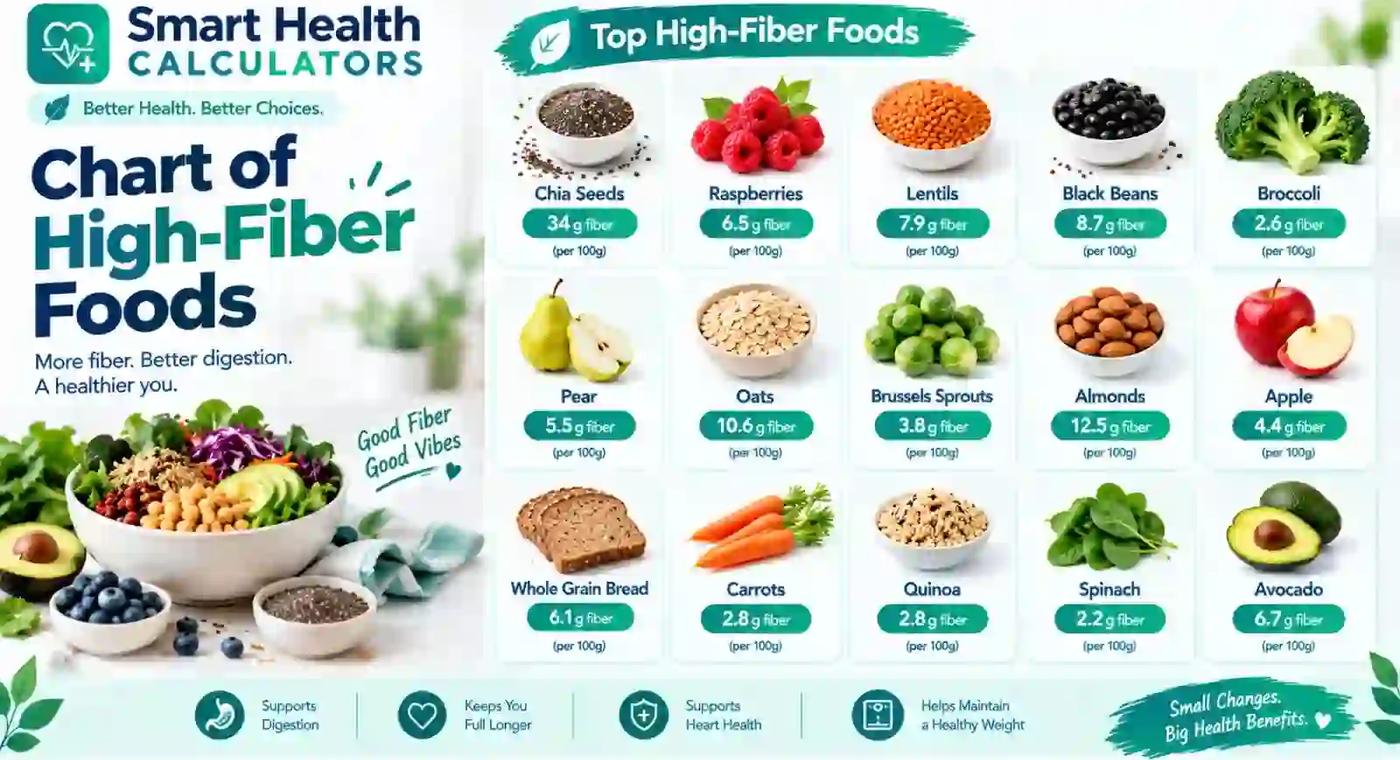
The highest-fiber foods per typical serving include split peas, lentils, black beans, and chia seeds — each delivering well over 30% of the FDA's 28-gram Daily Value in a single cup or two-tablespoon serving. This chart ranks common foods by grams of fiber per standard serving, drawing on USDA food composition data, so you can see exactly which foods do the heavy lifting toward your daily fiber goal.
Most "high fiber foods" lists online either bury the actual numbers in vague descriptions or mix up serving sizes so badly that comparing two foods becomes meaningless. This chart fixes that by using one consistent measurement approach throughout — fiber grams per standard serving size — with the food's typical Daily Value percentage included, so you can scan it quickly and actually use it for meal planning.
How to Read This Fiber Chart
Before diving into the numbers, a quick note on methodology, since this single detail determines whether a fiber comparison is actually meaningful or misleading.
Serving size matters enormously. A food ranked "high in fiber per 100g" can look completely different when ranked "per typical serving," since a typical serving of some foods (like chia seeds) is much smaller than 100g, while a typical serving of others (like cooked lentils) is larger. This chart uses standard, realistic serving sizes — the amount a person would actually eat in one sitting — rather than an arbitrary 100g comparison that doesn't reflect real eating patterns.
The FDA Daily Value (DV) reference matters too. The FDA currently lists 28 grams of dietary fiber as the Daily Value used on Nutrition Facts labels, based on a 2,000-calorie diet. A food is generally considered a "good source" of fiber at 10–19% DV per serving, and a "high" or "excellent" source at 20% DV or more. This chart includes approximate %DV for each food so you can quickly gauge how meaningfully it contributes to your day.
The Chart: Fiber Content by Food Category
Legumes and Pulses (The Fiber Champions)
Legumes consistently top fiber charts, and it's not close — they combine high fiber with meaningful protein, making them one of the most nutritionally efficient food categories on this entire list.
| Food | Serving Size | Fiber (g) | Approx. % DV |
|---|---|---|---|
| Split peas, cooked | 1 cup | ~16g | ~57% |
| Lentils, cooked | 1 cup | ~15g | ~54% |
| Black beans, cooked | 1 cup | ~15g | ~54% |
| Chickpeas, cooked | 1 cup | ~13g | ~46% |
| Kidney beans, cooked | 1 cup | ~11g | ~39% |
| Navy beans, cooked | 1 cup | ~19g | ~68% |
| Edamame, cooked | 1 cup | ~8g | ~29% |
If you're building meals around plant-based protein and fiber simultaneously, our guide on 51 most protein-rich foods ranked by protein density covers exactly how legumes stack up on the protein side of this equation too.
Whole Grains
Whole grains provide fiber alongside complex carbohydrates, though the fiber content varies considerably depending on how refined the grain is — a detail that matters more than most people realize.
| Food | Serving Size | Fiber (g) | Approx. % DV |
|---|---|---|---|
| Barley, cooked | 1 cup | ~6g | ~21% |
| Oats (rolled), cooked | 1 cup | ~4g | ~14% |
| Quinoa, cooked | 1 cup | ~5g | ~18% |
| Brown rice, cooked | 1 cup | ~3.5g | ~13% |
| Whole wheat bread | 2 slices | ~4g | ~14% |
| Bran cereal | 1 cup | ~7–10g (varies by brand) | ~7–10g (varies by brand) |
The gap between whole grain and refined grain versions of the same food is worth highlighting directly: white rice contains a fraction of brown rice's fiber content, since the bran layer where most of the fiber resides is removed during refining. Choosing the whole-grain version of a staple food is one of the simplest, most repeatable ways to boost daily fiber without changing your overall eating pattern.
Fruits
Fruits provide fiber alongside vitamins and natural sugars, and whole fruit consistently outperforms juice on this front, since juicing removes most of the fiber-containing pulp and skin.
| Food | Serving Size | Fiber (g) | Approx. % DV |
|---|---|---|---|
| Raspberries | 1 cup | ~8g | ~29% |
| Pear (with skin) | 1 medium | ~6g | ~21% |
| Apple (with skin) | 1 medium | ~4.5g | ~16% |
| Banana | 1 medium | ~3g | ~11% |
| Orange | 1 medium | ~3g | ~3g |
| Avocado | Avocado | ~5g | ~18% |
Berries as a category tend to outperform most other fruits on a per-serving basis, largely because their edible seeds contribute additional insoluble fiber that most other fruits don't carry in the same quantity.
Vegetables
Vegetables generally contribute more modest fiber amounts per serving compared to legumes, but their low calorie density means they're an efficient way to add fiber without a significant calorie cost.
| Food | Serving Size | Fiber (g) | Approx. % DV |
|---|---|---|---|
| Artichoke, cooked | 1 medium | ~7g | ~25% |
| Broccoli, cooked | Broccoli, cooked | ~5g | ~5g |
| Brussels sprouts, cooked | 1 cup | 1 cup | ~14% |
| Sweet potato (with skin) | 1 medium | ~4g | ~14% |
| Carrots, raw | 1 cup | ~3.5g | ~13% |
| Spinach, cooked | 1 cup | ~4g | ~14% |
Nuts and Seeds
Nuts and seeds pack meaningful fiber into small serving sizes, making them useful for boosting intake without needing to eat large food volumes — though their higher calorie density means portion awareness matters more here than with vegetables.
| Food | Serving Size | Fiber (g) | Approx. % DV |
|---|---|---|---|
| Chia seeds | 2 tablespoons | ~10g | ~36% |
| Flaxseed, ground | 2 tablespoons | ~4g | ~14% |
| Almonds | 1 oz (~23 nuts) | ~3.5g | ~13% |
| Pumpkin seeds | 1 oz | ~5g | ~18% |
| Chestnuts | Chestnuts | ~1g | ~4% |
Chia seeds deserve special mention here — gram for gram, they're one of the most fiber-dense foods in this entire chart, largely due to their unusually high soluble fiber content, which forms a gel-like consistency when combined with liquid.
Understanding Fiber Types: Why Not All Fiber Behaves the Same
This chart lists total fiber content, but it's worth understanding that fiber isn't a single uniform substance. NIH research specifically notes that different fiber types can produce different physiological effects, and individual responses vary — meaning two foods with identical total fiber numbers can behave quite differently in your digestive system.
Soluble fiber dissolves in water, forming a gel-like substance. Oats, chia seeds, and legumes are particularly rich in this type, and it's specifically associated with supporting healthy cholesterol levels and moderating blood sugar response.
Insoluble fiber doesn't dissolve and instead adds bulk to stool, supporting regular bowel movements. Whole grains, vegetable skins, and nuts tend to be richer in this type.
Most whole foods contain a mix of both types rather than being purely one or the other, which is exactly why a varied diet across food categories — rather than relying on a single "fiber food" — tends to provide more complete benefits than focusing on one category alone.
How Much Fiber Do You Actually Need?
This chart is only useful once you know your target. NIDDK's current guidance states that adults generally need 22–34 grams of fiber per day, depending on age and sex, while the broader Dietary Reference Intake framework uses 14 grams per 1,000 calories as its foundational Adequate Intake formula.
This means fiber needs genuinely differ from person to person based on calorie intake, not just a flat number that applies to everyone. If you want your personalized target calculated against your actual calorie needs rather than a population average, our detailed guide on dietary fiber intake and how much you need walks through the full age- and sex-specific breakdown, and our Calorie Intake Planner can establish your calorie baseline first.
Building a Full Day of High-Fiber Eating
Rather than fixating on a single "highest fiber food," the more practical approach is spreading fiber-rich choices across your day. Here's what that might look like using foods from this chart:
- Breakfast: Oatmeal (4g) topped with raspberries (8g) and a tablespoon of chia seeds (5g) — roughly 17g before you've even reached lunch
- Lunch: A cup of lentil soup (15g) with a side of whole wheat bread (4g) — another 19g
- Dinner: Grilled chicken with a cup of broccoli (5g) and a serving of quinoa (5g) — 10g more
- Snack: An apple with the skin on (4.5g) or a handful of almonds (3.5g)
Stacked across a full day, this pattern comfortably reaches or exceeds the 22–34 gram range NIDDK cites for most adults, without requiring any single "miracle" high-fiber food to do all the work.
Increasing Fiber Intake Without Digestive Discomfort
If your current intake sits well below your target, jumping straight to the high end of this chart in one day is a common mistake that tends to backfire. NIDDK specifically recommends increasing fiber gradually and ensuring adequate fluid intake alongside the increase, since a rapid jump commonly triggers gas, bloating, or digestive discomfort.
A practical approach:
- Add one high-fiber food every few days rather than overhauling your entire diet at once
- Increase water intake alongside fiber, since fiber — particularly insoluble fiber — needs adequate fluid to move through your digestive system comfortably. Our daily water intake guide and Water Intake Calculator can help you calibrate this correctly
- Spread fiber-rich foods across meals rather than loading them all into one sitting
- Pay attention to how your body responds, and slow the pace of increase if you notice persistent discomfort
Common Misconceptions About High-Fiber Foods
"Fiber supplements are just as good as fiber-rich foods." Whole foods deliver fiber alongside a broader nutritional package — vitamins, minerals, and in the case of legumes, protein — that an isolated supplement doesn't replicate. Supplements can help close a specific gap, but they shouldn't be the primary fiber strategy for most people.
"All fruit is equally high in fiber." As this chart shows, berries and pears meaningfully outperform bananas and oranges per serving — treating "fruit" as one uniform fiber category oversimplifies real, measurable differences.
"Juice counts the same as whole fruit for fiber." Juicing removes most of the pulp where fiber concentrates, meaning fruit juice contributes far less fiber than eating the same fruit whole, even when the calorie and sugar content look similar.
"More fiber is always better, no matter how fast you add it." As covered above, rapid increases without adequate water intake commonly cause genuine digestive discomfort — pace and hydration matter as much as the total amount.
Frequently Asked Questions
What foods are highest in fiber?
Legumes consistently rank highest per serving — split peas, navy beans, lentils, and black beans all provide roughly 11–19 grams of fiber per cooked cup, representing 39–68% of the FDA's Daily Value in a single serving.
How much fiber is in common foods?
It varies significantly by food and serving size — a cup of cooked lentils provides about 15 grams, an apple with skin provides about 4.5 grams, and two tablespoons of chia seeds provide about 10 grams, making legumes and seeds particularly fiber-dense per serving.
Which fruits contain the most fiber?
Raspberries and pears rank among the highest-fiber fruits per serving, at roughly 6–8 grams each, considerably more than bananas or oranges at around 3 grams per serving.
Are beans a good source of fiber?
Yes — beans and other legumes are consistently among the most fiber-dense whole foods available, typically providing 8–19 grams of fiber per cooked cup depending on the specific type.
Which foods contain soluble versus insoluble fiber?
Oats, chia seeds, and legumes are particularly rich in soluble fiber, which supports cholesterol and blood sugar management, while whole grains, vegetable skins, and nuts lean more toward insoluble fiber, which supports regular bowel movements. Most whole foods contain a mix of both.
How can I increase my fiber intake without digestive discomfort?
Increase fiber gradually rather than all at once, drink adequate water alongside the increase, and spread fiber-rich foods across multiple meals rather than concentrating them in a single sitting.
What is considered a high-fiber food?
Using the FDA's Nutrition Facts labeling benchmark, a food providing 20% or more of the 28-gram Daily Value per serving (roughly 5.6 grams or more) is generally considered a "high" or "excellent" source of fiber.
The Bottom Line
Legumes, whole grains, fruits with edible skins, and a handful of nuts and seeds do the heavy lifting on this fiber chart, and the practical path to hitting your daily target isn't finding one miracle food — it's spreading a handful of these choices naturally across your meals throughout the day. Given how much fiber values can shift with variety, preparation method, and specific serving size, treat the figures here as a solid planning reference and check USDA FoodData Central directly for the exact figure on any specific product or brand you're tracking closely.
If you want to build a complete eating plan around your personalized fiber and calorie targets rather than estimating from general averages, start with our dietary fiber intake guide to calculate your specific daily target, then use the Diet Plan Generator to build meals around the high-fiber foods from this chart that fit your goals.
Medical Disclaimer
This article is for general education only. It is not medical advice, diagnosis, treatment, prescription guidance, or a replacement for professional healthcare. Speak with a qualified healthcare professional for personal medical concerns, symptoms, pregnancy concerns, mental health crisis, medication questions, or before making major health changes.