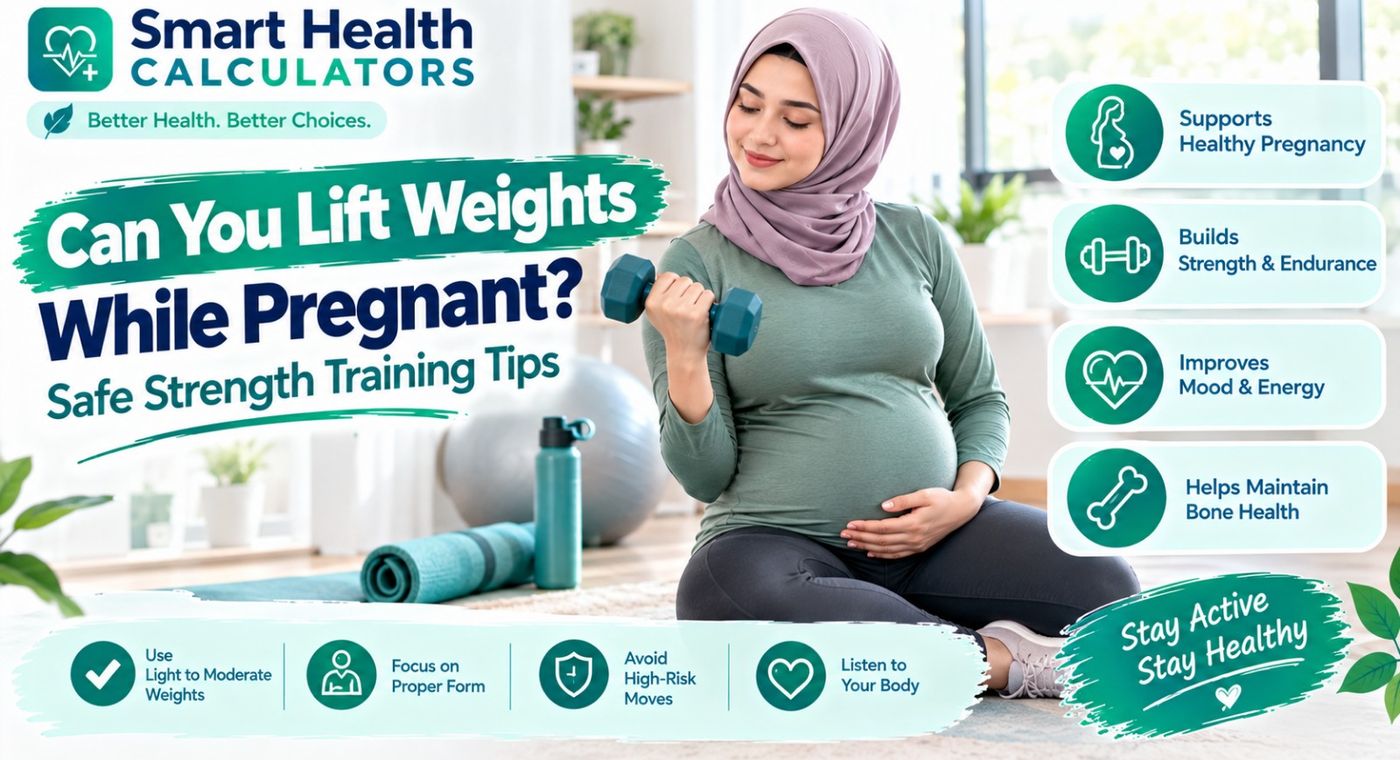
Lifting Weights While Pregnant: Safety & Best Exercises
Lifting weights while pregnant can be safe with the right approach. Learn safe weights, exercises, trimester tips, and key pregnancy lifting guidelines.
Public health agencies agree. The CDC and the World Health Organization both point to at least 150 minutes of moderate-intensity aerobic activity per week for healthy pregnant people. The WHO also recommends including muscle-strengthening activities. The NHS says that if you already do strength training at a gym, you can generally keep doing it with adjustments.
There is no single maximum weight that applies to everyone. That's deliberate. The safe load for a woman who has deadlifted for ten years differs from the safe load for someone starting this month. Effort level, technique, and how you feel matter more than a number on the bar.
What Does "Lifting Weights While Pregnant" Actually Mean?
Prenatal strength training is resistance exercise adjusted for the physical changes of pregnancy. It can use dumbbells, kettlebells, resistance bands, cable or weight machines, or your own bodyweight.
It is not the same as chasing personal records or heavy one-rep maxes. Think of it as maintaining and building the muscular strength you'll use for carrying a baby, getting up from the floor, and recovering after birth.
A typical prenatal session includes:
- A warm-up of 5–10 minutes of walking, arm circles, and gentle mobility
- Resistance exercises for the legs, back, chest, shoulders, and glutes
- Core and pelvic floor work focused on stability rather than crunching
- A cool-down with light stretching and slow breathing
Sometimes people use "resistance training" and "strength training" interchangeably, and that works fine here. Both mean making muscles work against a load.
Why Strength Training Matters During Pregnancy
Pregnancy is a nine-month physical event. Your center of gravity shifts forward, pregnancy hormones soften connective tissue, and your abdominal wall stretches. Stronger muscles help you handle each of those changes.
Here's what resistance training can realistically offer:
- Less low back and pelvic discomfort. Strong glutes, upper back, and deep core muscles share the load that your lower back would otherwise carry alone.
- Better posture. Rows and pulling exercises counter the forward-rounding that heavier breasts and a growing belly encourage.
- Joint stability. Muscle support around your hips, knees, and pelvis helps when ligaments are looser than usual.
- Stamina for labor and recovery. Muscular endurance matters in a long labor and in the physically demanding first weeks with a newborn.
- Mood and energy. Many people find a short strength session lifts a flat day.
- Support for healthy sleep. Daytime activity often makes nighttime rest easier. Our guide to sleep during pregnancy goes deeper on this.
Researchers have also studied links between prenatal exercise and lower risks of conditions such as gestational diabetes. Those findings are associations, not guarantees, so ask your clinician how they apply to your pregnancy.
Can Lifting Weights Cause a Miscarriage?
This is one of the most searched worries, so here is a direct answer. For uncomplicated pregnancies, there is no good evidence that moderate exercise, including resistance training, causes miscarriage. Most early pregnancy losses are linked to chromosomal problems in the embryo, not to anything the parent did or didn't do.
That doesn't mean "anything goes." Activities with high risk of falls or blows to the abdomen deserve caution. If you have a history of miscarriage, bleeding, cervical problems, or other complications, your clinician may give you individual restrictions. Follow those over any general guide.
If you've been lifting and then had a loss, that is not evidence you caused it. Please be gentle with yourself and talk with your care team.
Before You Lift: The Safety Rules That Apply to Every Session
Good strength training starts with good guardrails.
1. Get the green light from your care team
ACOG recommends discussing exercise with your obstetric clinician, especially if your pregnancy is complicated. Ask specifically about lifting, since your clinician knows your history, placenta position, blood pressure, and cervical status.
2. Judge effort with the talk test and perceived exertion
Skip rigid heart-rate targets. Pregnancy changes your resting heart rate, so a fixed number can mislead you. Instead:
- Talk test: You should be able to hold a conversation between sets. If you can only gasp a word or two, lower the intensity.
- Borg Rating of Perceived Exertion: ACOG identifies 13–14 on the Borg scale ("somewhat hard") as a way to monitor moderate-intensity exercise.
ACOG also notes that an upper safe intensity limit hasn't been firmly established. That's another reason to stay in the "challenging but controlled" zone rather than going to failure. If you're curious how heart-rate training works outside pregnancy, our heart rate zone calculator guide explains it, though pregnancy calls for the effort-based approach above.
3. Leave reps in the tank
A practical rule: finish each set feeling you could do two or three more clean repetitions. If your form breaks down, the set is over. Training to failure isn't the goal.
4. Breathe through the effort
Avoid the Valsalva maneuver, where you hold your breath and bear down. It spikes abdominal pressure. Exhale during the hard part of the lift (standing up from a squat, pressing a weight away) and inhale on the easier phase.
5. Stay cool and hydrated
Overheating is a real concern. Train in a cool, ventilated space, wear breathable clothing, and keep water nearby. Our pregnancy water intake guide explains how much fluid you may need, and the water intake calculator gives a personalized estimate. For timing around sessions, read how much water to drink before a workout. If you live somewhere hot, such as much of Pakistan or the Gulf, our piece on drinking water in extreme heat is a useful companion.
6. Fuel properly
Lifting burns energy, and pregnancy raises your nutritional needs. Protein, in particular, supports muscle maintenance. Our guide on how much protein you need per day is a starting point, and the calorie intake planner can help you estimate energy needs. Ask your clinician or a dietitian for pregnancy-specific targets.
7. Be careful lying flat on your back
Guidance varies by source. ACOG discusses reduced venous return with prolonged supine exercise later in pregnancy, while the NHS advises avoiding exercises that involve lying flat on your back for more than a few minutes, particularly after about 16 weeks. Don't memorize one magic week. Instead:
- Use an inclined bench or prop your upper body on pillows.
- Choose seated, standing, side-lying, or all-fours versions of exercises.
- Change position at once if you feel dizzy, nauseated, or short of breath.
How Much Weight Can You Lift While Pregnant?
This is the question behind most searches, and the honest answer is: it depends, and no universal pound or kilogram limit exists for recreational strength training.
Here's how to think about it in practice.
Use relative effort, not absolute numbers
Pick a weight that lets you complete your target reps with good form, steady breathing, and a few reps to spare. If a weight feels like a 13–14 out of 20 on the Borg scale, you're in a sensible range.
Consider your training background
| Your background | A sensible starting point |
|---|---|
| Experienced lifter | Continue your routine, but reduce loads and volume as needed, and drop max-effort or very heavy singles |
| Occasional exerciser | Moderate weights, 10–15 reps, slower progression |
| Complete beginner | Bodyweight or light dumbbells and bands, 8–12 reps, build gradually |
Expect your numbers to change
Many lifters find their usual weights feel harder as the months go by, even though they haven't "lost strength." Fatigue, pelvic pressure, shifting balance, and a bigger belly all play a role. Lowering the weight is smart programming, not failure.
Recreational lifting vs. occupational lifting
Lifting at the gym and lifting at work are different situations. Lifting limits for jobs depend on how often, how far, and under what conditions you lift. If your job involves repeated heavy lifting, talk to your clinician and your employer about adjustments. Don't treat gym guidance as a workplace rule.
A practical self-check
Ask yourself after every set:
- Could I have a conversation right now?
- Did my breathing stay controlled?
- Did I feel any pelvic pressure, coning, or leaking?
- Was my form still clean on the last rep?
If any answer is "no," reduce the load next set.
The Best Strength Exercises During Pregnancy
These movements suit many uncomplicated pregnancies. Each includes a modification so you can adapt it as your body changes.
Lower body
Goblet squat or chair squat
Hold one light dumbbell at your chest, feet hip-width or slightly wider. Sit back and down, then stand while exhaling. If balance is a concern, lightly tap a chair and stand. A wider stance makes room for your belly. Squats mirror everyday movements, which is why they're such a staple of prenatal programs.
Sumo squat
A wider stance with toes slightly turned out. It works the glutes and inner thighs and gives your growing belly room.
Romanian deadlift (light, hip hinge)
Hold light dumbbells and push your hips back with a soft knee bend and a flat back. Keep the weights close to your legs. If bending forward feels uncomfortable later in pregnancy, switch to a hip hinge with a band or a supported version.
Supported reverse lunge or split squat
Hold a chair or counter for balance. Lunges are an option for many pregnant women, but your center of gravity changes. If you feel wobbly or have pelvic girdle pain, swap in a supported split-stance hold.
Glute bridge on an incline
Prop your upper back on a bench or pillows so your torso stays inclined, then press through your heels. This avoids a fully flat position.
Calf raises
Hold a counter and rise onto the balls of your feet. They support circulation and ankle stability. If you ever notice one-sided calf pain or swelling, stop and contact your clinician.
Upper body
Seated dumbbell shoulder press
Use a chair with back support and press light weights overhead. Stop if it strains your neck or upper back.
One-arm dumbbell row or band row
Support one hand on a bench or sturdy table and pull the weight toward your hip. Rows counter the forward posture of pregnancy.
Incline dumbbell press or wall push-up
Set the bench at an incline so you're not flat. Wall push-ups are a gentler alternative with no pressure on your belly.
Lat pulldown or band pull-down
Great for the upper back. Keep your ribs down and avoid arching.
Biceps curls and triceps extensions (light)
Useful for the arm strength you'll lean on when lifting a car seat or carrying a baby.
Core and pelvic floor
Bird dog
From all fours, extend one arm and the opposite leg while keeping your hips level. It trains core stability without crunching.
Cat-cow and pelvic tilts
Gentle spinal mobility that soothes the lower back.
Pallof press with a band
Stand sideways to an anchored band and press straight out, resisting rotation. This builds deep core control with no forward flexion.
Pelvic floor contractions (Kegels)
Gently lift and tighten, hold 3–5 seconds, then fully relax for the same time. Relaxation matters as much as contraction, because the pelvic floor must release during birth. If you feel pain, pressure, or leaking, see a pelvic health physiotherapist.
Exercises to Avoid or Modify When Lifting
ACOG advises skipping activities with a notable risk of falls or abdominal impact. In the weight room, that translates into a few specific cautions:
- Heavy lifts with held breath. Avoid bearing down.
- Max-effort or near-max lifts. There's little benefit and more risk of strain.
- Exercises with high balance demands under load, such as heavy overhead lifts on one leg, Olympic-style lifts, or jumping with weights
- Long periods flat on your back, especially later in pregnancy
- Crunches, sit-ups, and full planks if they cause belly doming, coning, or pressure. Replace them with stability work.
- Deep twisting under load that compresses the abdomen
- Hot yoga or hot Pilates, due to overheating
- Anything that causes pain, pressure, leaking, or dizziness
A note on diastasis recti
If you see a ridge or bulge down the middle of your belly when you move, mention it to your clinician. It can indicate separation of the abdominal muscles (diastasis recti). It doesn't automatically mean you should stop training, but it may call for modified core work and guidance from a pelvic health physiotherapist.
How to Modify Strength Training by Trimester
Your routine shouldn't stay identical for nine months. This table gives a general overview.
| Stage | Common challenges | Helpful adjustments |
|---|---|---|
| First trimester | Fatigue, nausea, tender breasts | Reduce volume on rough days, keep intensity moderate, prioritize consistency, wear a supportive sports bra |
| Second trimester | Growing belly, shifting posture, often better energy | Maintain strength with supported or incline variations, widen stances, limit flat-back positions |
| Third trimester | Fatigue, pelvic pressure, reduced balance | Lighter loads, higher reps, more rest, seated or supported exercises, more mobility and breathing |
Strength training in the first trimester
Nausea and exhaustion can make training unpredictable. Many people keep their usual routine at a gentler intensity. Others scale back for a few weeks, then rebound. Both are normal.
If you're new to lifting, start with light weights and master the movement patterns. Don't feel pressure to "make up" sessions on better days.
Strength training in the second trimester
For many, this is the sweet spot. Energy often returns and your belly isn't yet in the way. It's a good window to maintain or build strength with the squats, rows, and hinges above. Start swapping flat-back exercises for incline or seated ones. If you're curious about what's happening in your body, see our article on 6 months pregnant symptoms and baby development.
Strength training in the third trimester
Yes, you can strength train in the third trimester if your clinician agrees. Focus on gentle strength, mobility, and preparation. Use lighter weights, more rest between sets, and chair or wall support for balance. Breathing practice and pelvic floor relaxation become more important now.
On heavy days, a slow walk and a few stretches count as a win.
Not sure which trimester or week you're in? The pregnancy calculator estimates your stage, and our guide to due dates and trimesters explains how milestones are counted. For a quick conversion, see pregnancy weeks to months.
When to stop lifting altogether
There's no universal cutoff week. Some people lift until the final weeks with adjustments, and others stop earlier due to discomfort or medical advice. Your clinician may recommend stopping or changing your routine if you develop complications such as bleeding, placenta problems, preterm labor signs, or high blood pressure conditions.
Dumbbells vs. Resistance Bands vs. Machines: Which Is Best?
You don't need to choose a winner. Each tool has strengths.
| Option | Strengths | Watch-outs |
|---|---|---|
| Dumbbells | Easy to adjust, great for squats, rows, presses | Heavy loads can strain balance; drop weights safely |
| Resistance bands | Joint-friendly, portable, adjustable tension | Secure your anchor; avoid snapping or sudden release |
| Weight machines | Stable and guided, with less balance demand | Seat and belt positions may not fit a growing belly; adjust or skip |
| Cable machines | Smooth tension, versatile | Avoid twisting under heavy load |
| Kettlebells | Useful for goblet squats and hinges | Swings and fast ballistic movements raise balance and impact concerns |
| Bodyweight | No equipment, easy to modify | Limited progression in later months |
Free weights vs. machines
Machines add stability, which many people appreciate late in pregnancy. Free weights train balance and coordination but demand more control. A mix often works best.
Heavy vs. moderate lifting
Heavy, near-max lifting isn't usually necessary for the goals of pregnancy, such as strength maintenance, comfort, and labor readiness. Moderate loads with higher reps offer most of the benefit with less strain.
Squats vs. lunges
Squats are generally more stable. Lunges add balance and single-leg demands. If your pelvis feels unstable, choose squats or supported split squats.
Strength training vs. cardio vs. walking
They complement each other. Cardio supports heart and lung fitness, walking is accessible and gentle, and strength training protects muscle, posture, and joints. For a broader look at balancing the two, read our post on cardio and strength training. Use the step counter goal planner to set a realistic walking target.
Strength training vs. prenatal yoga
They aren't rivals. Prenatal yoga builds flexibility, breath, and relaxation, while resistance training builds the strength to support your body. A weekly mix of both covers more ground. Choose prenatal-specific, non-heated classes.
A Sample Weekly Prenatal Strength Plan
This beginner-to-intermediate plan fits an uncomplicated pregnancy. Adjust it to your energy, symptoms, and clinician's advice. The NHS suggests including muscle-strengthening activity on two days a week as part of general guidance, so this template uses two or three strength days.
| Day | Focus | Example exercises | Sets × reps | Time |
|---|---|---|---|---|
| Monday | Lower body + core | Goblet squat, light Romanian deadlift, supported reverse lunge, bird dog | 2–3 × 8–12 | 30–40 min |
| Tuesday | Walk + mobility | Brisk walk, cat-cow, pelvic tilts | N/A | 20–30 min |
| Wednesday | Upper body | Seated shoulder press, one-arm row, incline press, band pull-down | 2–3 × 8–12 | 30 min |
| Thursday | Rest or gentle walk | Easy stroll, light stretching | N/A | 10–20 min |
| Friday | Full body | Sumo squat, incline glute bridge, band rows, Pallof press, Kegels | 2 × 10–12 | 30–35 min |
| Saturday | Low-impact cardio | Stationary bike or brisk walk | N/A | 20–30 min |
| Sunday | Rest | Breathing and gentle stretching | Optional | N/A |
Rest 60–90 seconds between sets, or longer when you need it.
How to progress safely
- Master form first. Move slowly with control.
- Add reps before weight. Go from 8 to 12 reps, then consider a small increase.
- Adjust, don't force. If you're tired, cut a set or lower the weight.
- Track how you feel. A short log of effort, energy, and symptoms helps you spot patterns.
If you'd like help structuring your weeks, the workout planner can turn goals into a schedule, and our monthly workout planner guide shows how to track progress. For general program structure, see how to structure a workout plan from beginner to advanced, and adapt it with your clinician's input. Common planning pitfalls are covered in workout planning mistakes that slow results.
Short on time? A 20-minute session
- 3 minutes of marching in place and arm circles
- 2 × 10 goblet squats
- 2 × 10 one-arm rows per side
- 2 × 8 seated shoulder presses
- 2 × 8 bird dogs per side
- 5 pelvic floor contractions with full relaxation
- 2 minutes of slow breathing and stretching
Low-energy days
Do any two: a 10-minute walk, five minutes of cat-cow and pelvic tilts, or a few seated pelvic floor contractions. Showing up in a small way keeps the habit alive.
Warning Signs: When to Stop Exercising Immediately
ACOG identifies warning signs that mean you should stop exercising. These are medical warnings, not ordinary workout discomfort. Stop and contact your healthcare provider if you notice:
- Vaginal bleeding
- Abdominal pain
- Regular, painful contractions
- Fluid leaking from the vagina
- Dizziness or feeling faint
- Headache
- Chest pain
- Shortness of breath before you've started exerting yourself
- Muscle weakness affecting your balance
- Calf pain or swelling
If symptoms feel severe or frightening, seek emergency care rather than waiting for a callback. Our guide to pregnancy symptoms by trimester can help you understand common changes, but it can't tell you whether a specific symptom is safe. Your care team can.
Gym Safety Checklist for Pregnant Lifters
Print this or save it to your phone.
Before you go
- Confirm exercise is appropriate with your clinician
- Eat a light snack and hydrate
- Wear a supportive sports bra and non-slip shoes
While you train
- Warm up for 5–10 minutes
- Use the talk test and the 13–14 Borg target
- Exhale on effort, never hold your breath
- Use a bench with an incline rather than lying flat
- Wipe down equipment and keep a clear space around you
- Avoid unstable surfaces and rushed movements
- Ask a trainer for help with racks and heavy plates, and skip anything you'd need to lift overhead from the floor
After you train
- Cool down and stretch gently
- Rehydrate
- Note anything unusual and report it if it persists
If the gym is crowded, loud, or hot, a home session with bands and light dumbbells is a good backup. Our beginner home workout plan without equipment shows how simple routines are built.
A related point for heavy sweaters: our post on whether you need electrolytes for weight training may help, but ask your clinician before adding supplements during pregnancy.
Should You Start Lifting If You've Never Done It?
Yes, with a gradual approach. ACOG advises previously inactive people to begin gradually, and the NHS gives similar advice about building up slowly.
A beginner path might look like this:
- Weeks 1–2: Bodyweight movements and light bands, 10–15 minutes, two days a week
- Weeks 3–4: Add light dumbbells, 15–20 minutes
- After that: Progress to 20–30 minutes while staying within the talk test
Don't start a heavy program in pregnancy. This is a time to build habits and comfort, not to test your limits.
Why Choose Smart Health Calculators
Planning a strong, healthy pregnancy involves more than one workout. Why choose Smart Health Calculators? Because the site pairs free, easy-to-use calculators with clear guides that explain what the numbers mean.
You can estimate your due date with the pregnancy calculator, plan hydration with the water intake calculator, and map your weeks with the workout planner. When you want more, explore advanced tools at Smart Health Calculators and browse our free health calculators guide.
These tools support your decisions but never replace personal medical advice.
Frequently Asked Questions
Can you lift weights while pregnant?
Yes, for most uncomplicated pregnancies. ACOG, the CDC, the NHS, and the WHO support regular physical activity, including strength training, for healthy pregnant women. Your clinician should confirm it's right for you, especially if you have complications.
Is lifting weights safe during pregnancy?
It is generally considered safe when you use moderate loads, good form, controlled breathing, and avoid overheating and high-risk movements. Stop and seek advice if you notice any warning signs.
How much weight can you lift while pregnant?
There's no universal limit. Choose a weight that lets you finish your reps with good form and steady breathing, and that feels "somewhat hard" (13–14 on the Borg scale). Experienced lifters often reduce loads over time, and beginners should start light.
Can lifting weights cause a miscarriage?
For uncomplicated pregnancies, there's no good evidence that moderate strength training causes miscarriage. Most early losses are linked to chromosomal factors. If you have a history of complications, ask your clinician for personalized advice.
Can I lift weights in the first trimester?
Usually yes. Many people continue their usual routine at a gentler intensity, especially if nausea or fatigue hits. Beginners can start with light weights or bands.
Can I lift weights in the third trimester?
Often yes, with adjustments. Use lighter loads, more rest, and supported exercises, and avoid prolonged flat-back positions. Stop if you feel pelvic pressure, dizziness, or other warning signs.
Are resistance bands safe during pregnancy?
Yes, for most people. Bands are joint-friendly and easy to adjust. Check them for wear and secure your anchor point so they don't snap back.
How often should pregnant women strength train?
Many guidelines suggest two or more muscle-strengthening sessions per week as part of overall activity. Two or three short sessions is a realistic starting point. Don't treat any frequency as a mandatory target.
What exercises should I avoid when lifting weights while pregnant?
Skip max-effort lifts, breath-holding, high-fall-risk movements, prolonged flat-back positions, and anything that causes pain, pressure, leaking, or belly doming.
Do I need my doctor's approval before lifting weights?
It's strongly advised. ACOG recommends discussing exercise with your obstetric clinician, especially when pregnancy is complicated.
Conclusion: Your Next Step
Lifting weights during pregnancy can be safe, practical, and genuinely helpful when you tailor it to your body. Use moderate loads, exhale through effort, keep the talk test in mind, and adapt each trimester. The best routine is the one you can do consistently without pain, pressure, or fear.
Medical Disclaimer
This article is for general education only. It is not medical advice, diagnosis, treatment, prescription guidance, or a replacement for professional healthcare. Speak with a qualified healthcare professional for personal medical concerns, symptoms, pregnancy concerns, mental health crisis, medication questions, or before making major health changes.